You rest for a week, get some hands-on treatment, maybe feel looser for a day or two, then the pain creeps back in when you sit too long, train hard, or pick up where you left off. That cycle is exactly why the conversation around active rehab versus passive treatment matters. If your goal is not just to feel better for an afternoon but to get back to lifting, running, working, or living with more confidence, the type of care you choose makes a big difference.
A lot of people have had some form of passive care. That might mean massage, adjustments, modalities, stretching done to you, heat, ice, laser, shockwave, or cupping. None of those are inherently bad. In the right situation, they can reduce pain, calm an irritated area down, improve short-term mobility, and help you tolerate movement better.
The problem starts when passive treatment becomes the whole plan.
If your shoulder hurts every time you press overhead, or your back keeps flaring up after deadlifts, symptom relief alone usually does not build the strength, control, tolerance, or confidence needed to keep that issue from returning. You may leave each session feeling better, but still have no clear answer for why the pain keeps showing up under load, at work, or during sport.
What active rehab versus passive treatment really means
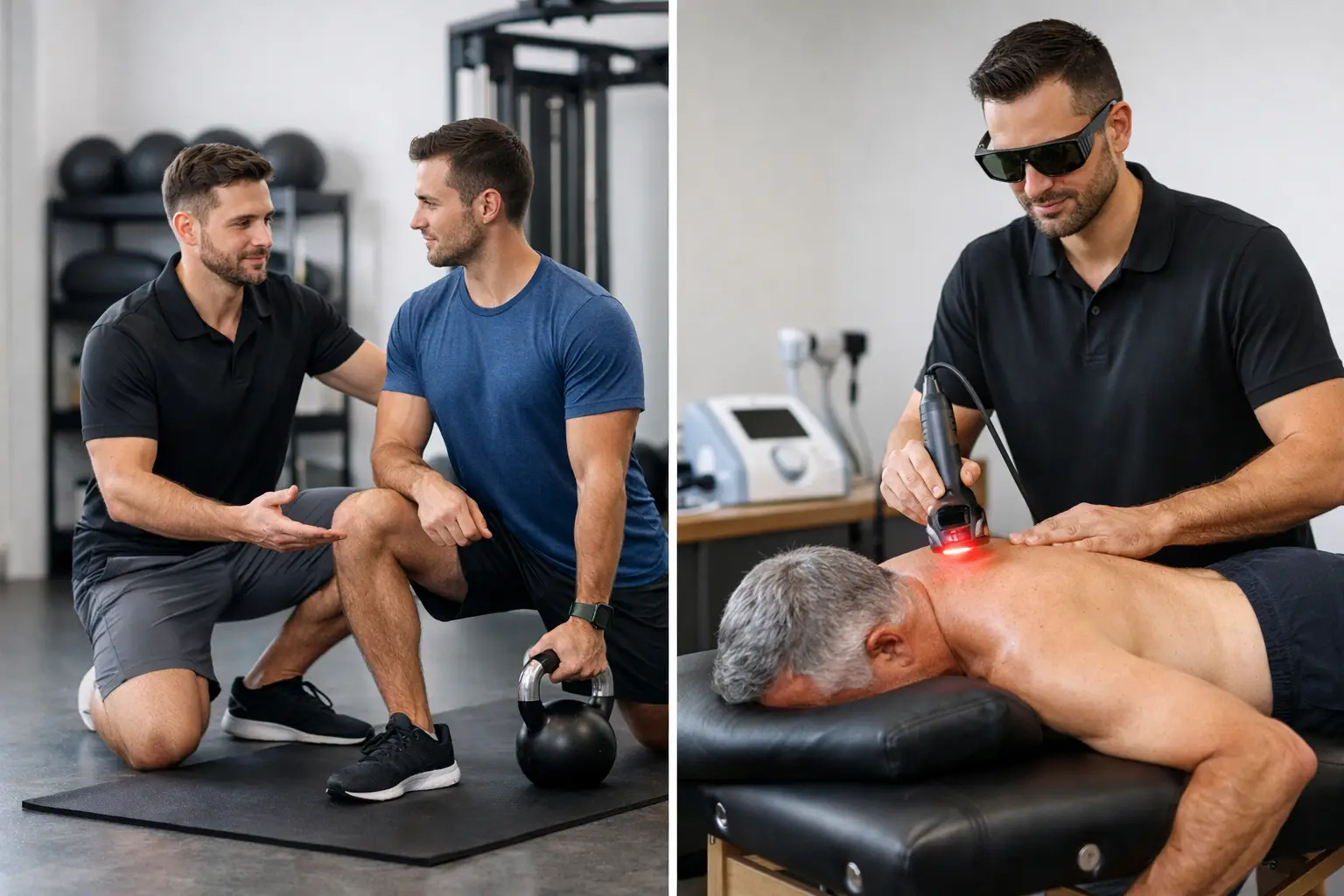
Passive treatment is care done to you. It can include chiropractic adjustments, soft tissue therapy, massage therapy, joint mobilization, shockwave therapy, Class IV laser therapy, cupping, or other hands-on approaches. These tools can be useful for reducing pain and improving comfort, especially early on when movement feels limited or symptoms are irritable.
Active rehab is different. It means you are part of the recovery process. It includes targeted mobility work, exercise progressions, strength training, movement retraining, balance work, loading strategies, and return-to-sport or return-to-work progressions based on what you actually need to do in real life.
That distinction matters because pain does not always stick around only because a tissue is irritated. Sometimes the bigger issue is loss of capacity. A body part that has become stiff, weak, deconditioned, poorly controlled, or sensitive to certain movements may need more than temporary relief. It often needs a gradual rebuilding process.
Why passive treatment can feel good but still fall short
This is where many active adults get stuck. Passive care often works fast enough to make you think the problem is solved. Your neck loosens up. Your hip feels less pinchy. Your low back settles down. That short-term change is real and can be helpful.
But if you go right back to the same training errors, same workload spikes, same desk setup, same movement limitations, or same lack of strength in key positions, the symptoms often return.
That does not mean hands-on care failed. It usually means it was only one piece of the puzzle.
For example, if a runner has ongoing calf tightness, massage may reduce tension for a bit. But if that runner also has poor ankle mobility, low calf endurance, sudden mileage increases, and weakness through the foot and hip, the lasting fix is rarely just more massage. The body needs a better plan.
The same applies to gym-goers with recurring shoulder pain, desk workers with repeated neck flare-ups, and golfers whose back pain shows up every round. If treatment does not progress into movement, capacity, and load tolerance, relief often stays temporary.
When passive treatment still has a real role
There is a tendency online to frame this as one side being right and the other being outdated. Real rehab is more nuanced than that.
Passive treatment can be useful when pain is too high for meaningful exercise, when mobility is very restricted, or when someone needs a short-term reduction in symptoms to start moving more normally. In that setting, chiropractic care, physiotherapy, massage therapy, soft tissue work, joint mobilization, laser, shockwave, or cupping may help create a better starting point.
That is often the smartest use of these tools - not as a forever strategy, but as support for the bigger goal.
If a patient comes in with an angry shoulder that cannot tolerate basic reaching, or an acute back flare-up that makes walking stiff and guarded, hands-on care may help calm things down enough to begin the active part of recovery. The key is that treatment should lead somewhere.
Why active rehab usually drives longer-term results
Your body adapts to what you ask it to do. If your recovery plan never asks it to regain strength, improve control, or tolerate load, you should not expect those qualities to improve on their own.
Active rehab helps close the gap between feeling better and actually functioning better. That matters whether you are a parent lifting kids, a desk worker sitting through long days, or an athlete trying to return to training without hesitation.
Good active rehab is not random stretching and a printout of generic band exercises. It starts with a detailed assessment. What movements hurt? What positions are limited? What is weak, stiff, overworked, undertrained, or poorly tolerated? What does this person need to get back to doing?
From there, the plan becomes specific. One person with knee pain may need quad strength and landing mechanics. Another may need ankle mobility, hip control, and a gradual running progression. Two people can have similar pain but need very different rehab.
That is also why exercise alone is not automatically the answer. The right exercise, at the right time, with the right dosage, is what matters.
Active rehab versus passive treatment for athletes and active adults
If you train regularly, your injury plan should match your activity demands. That means rehab needs to prepare you for real movement, not just a pain-free treatment table.
A shoulder that needs to press, hang, throw, or carry has to be trained for those demands. A back that needs to tolerate deadlifts, long drives, or physical work has to rebuild tolerance in those positions. An ankle that needs to cut, jump, or run hills has to earn that capacity back.
This is where a rehab-focused clinic stands apart from a quick in-and-out model. The goal is not just to make symptoms quieter. The goal is to help you move well, load well, and trust your body again.
At Ground Up Chiropractic and Rehab in Hamilton, that process may include a combination of chiropractic treatment, soft tissue therapy, massage therapy, joint mobilization, shockwave therapy, Class IV laser therapy, cupping, mobility work, progressive rehab, and gym-based strength progressions. The important part is not the tool itself. The important part is using the right tool at the right stage, based on assessment and goals.
What a better rehab plan looks like
A strong plan usually starts by reducing whatever is making the problem hard to tolerate. That may include hands-on care and symptom modification. But it should quickly move into restoring motion, improving strength, building control, and gradually exposing you to the tasks that matter most.
If your goal is to return to squatting, your rehab should eventually include squat-related progressions. If your goal is to get through a workday without your neck locking up, your plan should address both your symptoms and your ability to tolerate those daily demands. If your goal is to run without Achilles pain, rehab should build tissue capacity, not just reduce tightness.
This is where people often feel the difference. Instead of wondering whether they will always need another appointment just to keep things manageable, they start to understand what is contributing to the issue and what they can do about it.
That shift matters. Confidence is part of recovery too.
So which one should you choose?
The honest answer is both can help, but they should not carry equal weight forever.
If you are in a lot of pain, highly irritated, or too limited to exercise properly, passive treatment can be a useful starting point. If you are dealing with recurring pain, stalled progress, repeated flare-ups, or difficulty getting back to training, work, or sport, active rehab usually needs to become the main driver.
Think of passive care as support and active rehab as the long-term builder. One can help create opportunity. The other helps you keep it.
If you have already tried rest, quick appointments, generic stretches, or treatment that helped for a day but never really changed the bigger picture, that does not mean you are broken. It usually means you need a more complete plan - one that looks at symptoms, movement, strength, lifestyle, and the specific things you want to return to.
The goal is not to choose a side in a rehab debate. The goal is to get the right mix of care, at the right time, so you can stop chasing temporary relief and start building something that lasts.
If that sounds like what you have been missing, booking an assessment is a practical next step. A good assessment should help you understand what is going on, what is likely contributing, and what your path back to training, work, sport, or daily life could realistically look like.
The best rehab plan should leave you with more than a short-lived change in symptoms. It should leave you stronger, clearer, and more capable than when you started.
