Back pain rehab exercises usually fail for one simple reason: they are given out like a generic checklist instead of matched to how you move, what irritates your back, and what you are trying to get back to. A desk worker with morning stiffness, a parent who flares up lifting kids, and a lifter who gets pain during deadlifts do not need the same plan. The right exercise is not just about the body part. It is about the demand you need your body to handle.
That is why random stretching, a few core drills from social media, or resting until things calm down often leads to the same cycle. You feel a bit better, you go back to normal activity, and the pain comes back. Good rehab should reduce symptoms, yes, but it should also rebuild movement options, strength, and confidence so your back can tolerate more again.
Why back pain rehab exercises need to be specific
Low back pain is rarely solved by one magic movement. Sometimes the problem is stiffness and poor tolerance to sitting or bending. Sometimes it is loss of strength and control after a flare-up. Sometimes it is training load, poor recovery, or repeating the same aggravating positions without enough capacity to handle them.
This is where people get stuck with generic advice. A stretch that feels great for one person can irritate someone else. Core work can help, but doing hard bracing drills too early can make some people guard even more. Even the classic advice to strengthen your glutes or stretch your hamstrings depends on what your actual limitation is.
The goal of rehab is not to chase perfect posture or avoid every movement that feels uncomfortable. The goal is to understand what your back currently tolerates, improve the weak links around it, and gradually expose you to the movements and loads you need for work, sport, training, and daily life.
What good back pain rehab exercises are trying to do
At the start, exercises often aim to calm things down and restore comfortable movement. That might mean finding positions that reduce guarding, teaching you how to move with less stiffness, or using controlled mobility to help you stop feeling locked up.
As things improve, the focus shifts. Now the exercise needs to build capacity. That could mean improving hip movement so your back does not do all the work, strengthening your trunk so it can handle lifting and carrying better, or retraining patterns like hinging, squatting, rotating, and getting up from the floor.
Later, rehab needs to look more like real life. If your goal is returning to the gym, your program should not stop at clamshells and bird dogs. If your goal is getting through a workday or playing with your kids without a flare-up, your rehab should eventually include the kind of carrying, bending, reaching, and repeated movement that your life demands.
A practical progression for back pain rehab exercises
Early-stage rehab often starts with low-threat movement. Walking, supported hip hinges, pelvic tilts, breathing drills, gentle trunk rotation, or repeated movements that feel relieving can be useful. The point is not to hunt for a perfect exercise. The point is to get you moving again without constantly poking the pain.
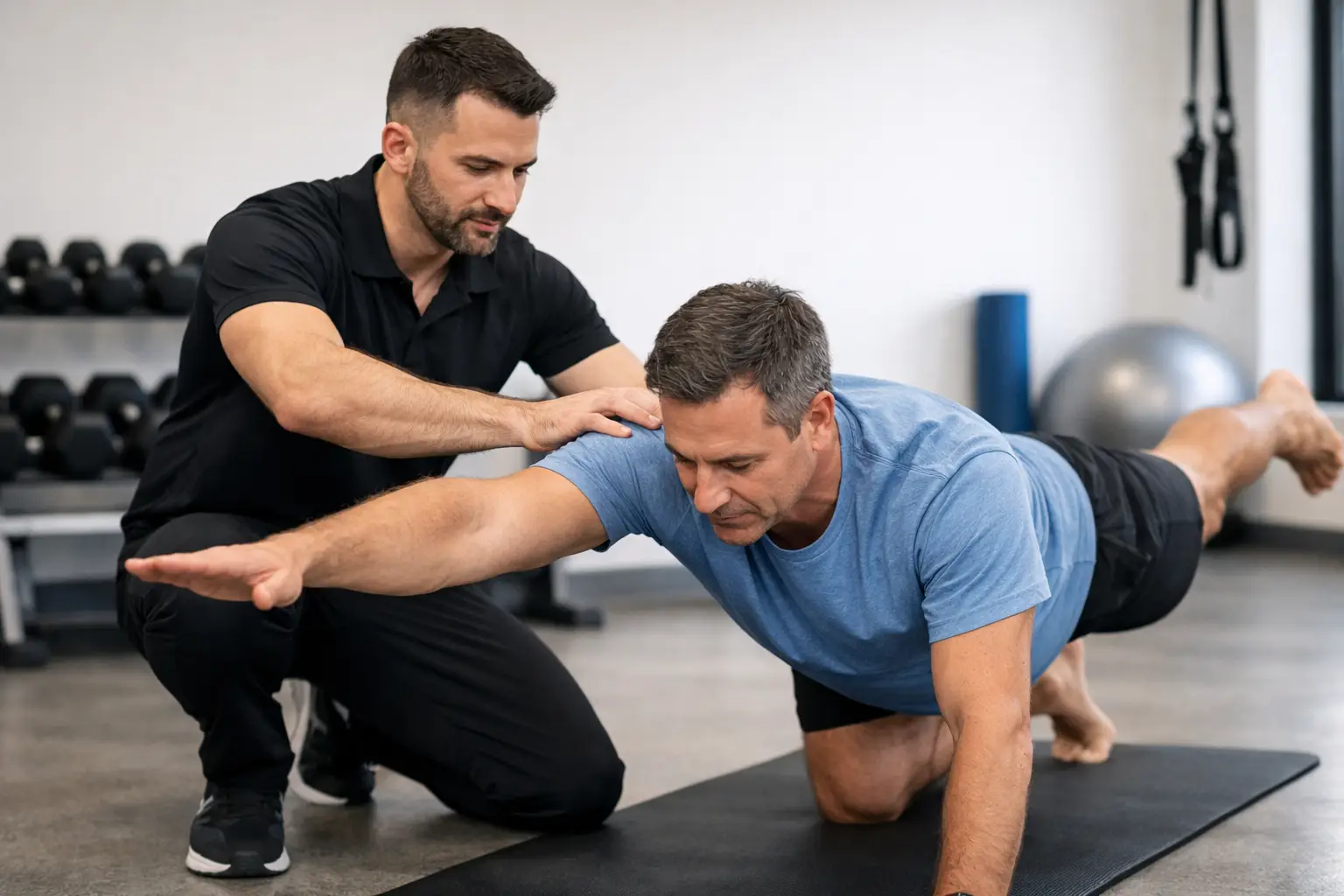
From there, trunk control becomes more important. Exercises like dead bugs, modified side planks, bird dogs, and loaded carries can help build coordination and endurance around the spine. These are not flashy, but they teach your body to manage force and movement better. For some people, this phase is where symptoms finally stop feeling so unpredictable.
Then comes strength. This is the part many people miss. If your back flares every time life gets heavier, your rehab likely needs more than stretching and mobility. Goblet squats, Romanian deadlift variations, split squats, step-ups, cable lifts, rows, and carries can all become part of a back rehab program when chosen properly. The key is dosage. The exercise has to challenge you enough to create change without exceeding what you can currently recover from.
If you are active, the final phase should look like return-to-performance work. That might mean progressing barbell lifts, running tolerance, rotational drills for golf, or repeated lifting for work demands. This is where rehab becomes truly useful. You are not just less sore. You are more capable.
When exercises help and when they backfire
Pain during rehab is not always a sign of damage, but it also should not be ignored. Some discomfort is acceptable if it stays mild, settles quickly, and does not leave you worse the next day. On the other hand, if every session causes a spike, your plan is probably too aggressive, too repetitive, or aimed at the wrong problem.
This is also why exercise selection matters less than exercise response. Two people can do the same movement and get opposite results. One feels looser and stronger. The other gets more guarded. Rehab should be adjusted based on what your body is telling us over time, not based on whether an exercise is popular.
A common mistake is doing too much too soon once pain starts easing. When you finally feel a good day, it is tempting to clean the whole house, crush a workout, or jump back into weekend sports. That sudden jump in load is one of the biggest reasons symptoms return. A better approach is to build in layers so your capacity rises with your activity.
Why passive care alone usually is not enough
Hands-on treatment can absolutely help. Chiropractic care, soft tissue therapy, joint mobilization, massage therapy, cupping, shockwave therapy, and Class IV laser therapy can all have a place when used for the right person at the right time. They can reduce sensitivity, improve movement, and create a window where exercise feels more manageable.
But that window still needs to be used well. If treatment gives temporary relief and nothing changes in how you move, train, recover, or load your body, the same issue often comes back. That is why a rehab-focused approach matters more than chasing the next quick fix.
At Ground Up Chiropractic and Rehab in Hamilton, that usually means combining a detailed movement assessment with the right mix of hands-on care, chiropractic treatment when appropriate, and progressive strength-based rehab in a gym setting. Not because every person needs every tool, but because most people need more than one angle if they want a lasting change.
What to look for in a rehab plan
A strong plan should make sense to you. You should understand what seems to be driving the pain, what the exercises are trying to improve, and what progress is supposed to look like over the next few weeks. You should also know what to do on better days, what to scale on worse days, and how to build back to your normal activities without guessing.
It should also match your real life. If you sit all day, your plan should account for that. If you lift, run, golf, or work a physical job, rehab should prepare you for those demands. If your schedule is packed, the program needs to be realistic enough that you can actually follow it.
Most of all, your program should evolve. Early rehab and later rehab should not look the same. If you are still doing the exact same low-level drills months later and not getting back to the things you care about, something is missing.
When to get assessed instead of guessing
If your pain has been lingering, keeps coming back, or has made you stop training, changing jobs tasks, or avoiding normal movement, it is worth getting assessed. The same goes for pain that is spreading, pain with weakness, or symptoms that are not responding to basic activity modification. And if you have severe pain, major neurological symptoms, or other concerning red flags, you should seek prompt medical evaluation.
An assessment matters because back pain is not one-size-fits-all. The exercises that help one person can stall another. A good rehab clinician will look at your symptoms, movement patterns, training history, daily demands, and current tolerance, then build a plan that actually fits.
That is where people usually start making progress. Not because they found a miracle exercise, but because they finally stopped treating all back pain like the same problem.
If your back has been limiting your training, work, or everyday life, the next step does not need to be more guessing. A well-built rehab plan should help you move better, get stronger, and trust your body again.
