Most runners do not need more random stretches. They need the right amount of strength, control, and load in the right places.
That is why the best rehab exercises for runners are not just the ones that feel good for five minutes. They are the ones that help you tolerate impact again, control force through the foot, ankle, knee, and hip, and build enough capacity to handle running without the same flare-up coming back every few weeks.
If you are dealing with Achilles pain, shin splints, runner’s knee, hamstring tightness, plantar heel pain, or an angry hip that shows up after every long run, exercise selection matters. But so does progression. A great exercise at the wrong stage is still the wrong exercise.
What makes the best rehab exercises for runners actually work?
The short answer is that good rehab exercises match the job running demands.
Running is a repeated single-leg task. Every step asks your body to absorb force, control rotation, manage stiffness, and then push you forward again. If rehab only includes passive care, light band work, or generic mobility drills, you might feel looser for a day but still be underprepared for the actual stress of running.
The best rehab plan usually includes a mix of pain management, mobility where needed, calf and foot strength, hip control, single-leg loading, and gradual return-to-impact work. It also depends on what is driving the problem. A runner with patellofemoral pain may need more hip and quad capacity. Someone with Achilles irritation may need heavy calf loading and a smarter return to speed work. Someone with recurring hamstring issues may need better trunk and pelvic control as much as hamstring strength.
That is the part many runners miss. The exercise is not magic. The match between the exercise, the runner, and the stage of rehab is what matters.
8 best rehab exercises for runners
1. Isometric calf raise hold
This is one of the simplest places to start when the calf or Achilles is irritated. Stand on both feet or one foot depending on tolerance, rise onto the ball of the foot, and hold. The goal is not to chase a stretch. The goal is to load the calf complex and tendon in a controlled way.
For some runners, isometrics help settle symptoms enough to keep moving while building early strength. They are especially useful when dynamic calf raises are still too irritating. If holding on one leg is too much, start with two legs and gradually shift more weight to the affected side.
2. Heavy slow calf raises
If you run, your calves do a huge amount of work. Yet many runners with lower-leg pain are surprisingly underloaded in rehab. Heavy slow calf raises build strength that actually transfers to running demands better than high-rep ankle pumps or endless stretching.
Do them with a straight knee and with a bent knee. The straight-knee version biases the gastrocnemius more. The bent-knee version brings the soleus in more, which matters because the soleus works hard during running, especially with longer efforts and hills. Tempo matters here. Slow up, pause, slow down.
3. Tibialis raises
Shin pain is not always just a mileage problem. It can also reflect a lower leg that is struggling to manage repeated loading. Tibialis raises can help build capacity at the front of the shin and improve lower-leg resilience.
Lean against a wall, lift the forefoot toward the shin, and control the lowering phase. This is not the only answer for shin splints or medial tibial stress symptoms, but it is often a useful piece of the puzzle when paired with calf work, foot strength, and smarter load management.
4. Short foot and toe control work
Your foot is not supposed to be a floppy passenger. It needs to help manage force and create a stable platform when you land and push off.
Short foot exercises, toe yoga, and controlled single-leg balance drills can improve foot awareness and local strength. These are not flashy, and they will not replace heavier strength work, but they can be valuable for runners dealing with plantar heel pain, recurrent ankle issues, or poor foot control during single-leg loading.
The key is not to grip the floor aggressively. Think subtle control, not cramping.
5. Step-downs
If you want a useful exercise for many cases of runner’s knee, step-downs belong high on the list. They train single-leg control, eccentric quad strength, and pelvic stability in a way that looks a lot more like running than sitting on a treatment table.
Use a low step first. Keep the movement controlled. Watch whether the knee caves inward, the pelvis drops, or the torso twists to escape the load. Those compensations often tell you more than pain alone. If form falls apart quickly, that is usually a capacity issue, not just a mobility problem.
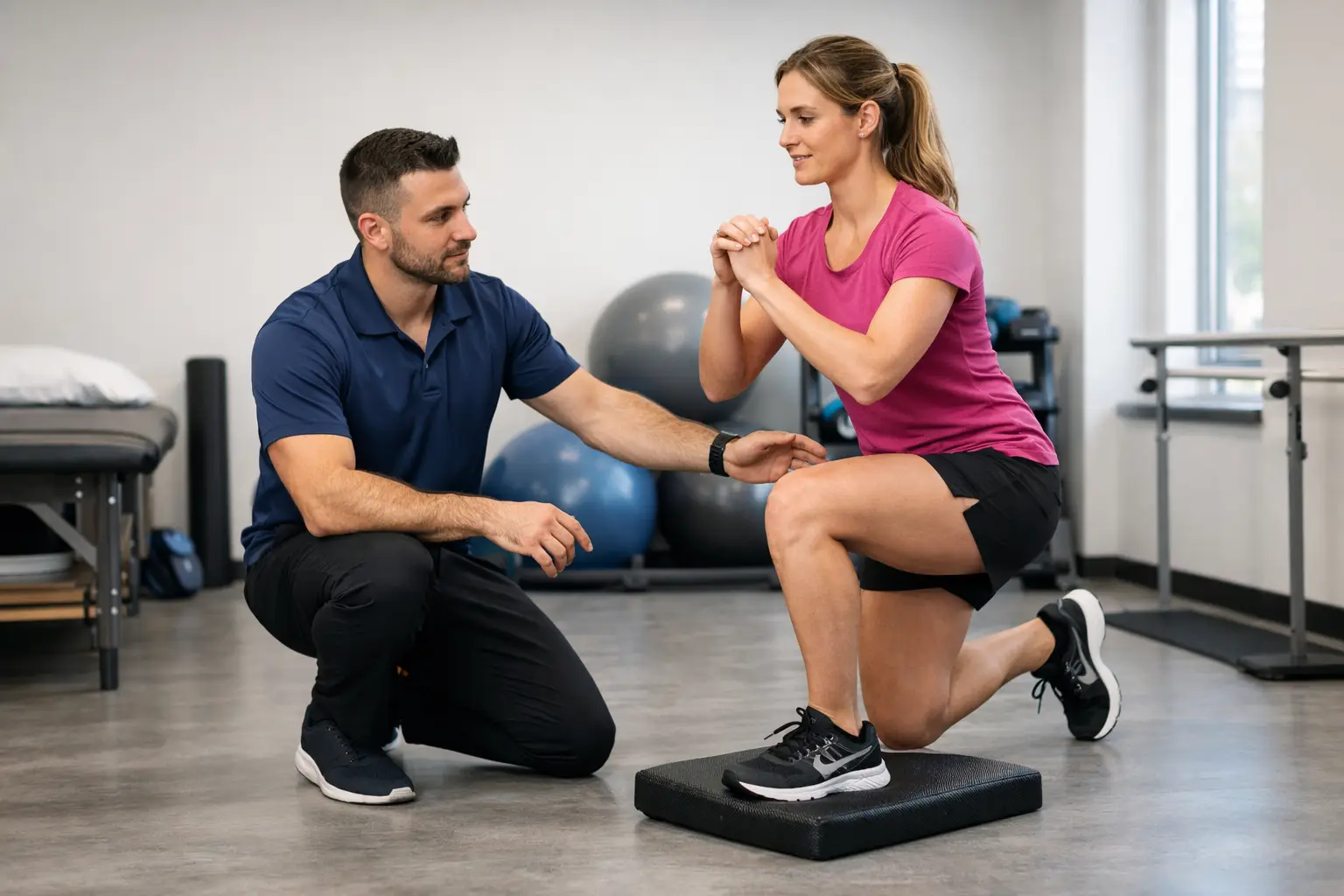
6. Split squats
Split squats are one of the most useful rehab and performance exercises for runners because they train the hips and legs under load while challenging balance and control. They can be adjusted easily based on tolerance, whether you are early in rehab or rebuilding strength for return to full training.
A more upright torso can bias the quad a bit more. A slight forward lean can bring in the glute more. Both can be useful depending on the issue. For runners with knee pain, hip weakness, or general deconditioning after time off, split squats often become a cornerstone exercise.
7. Single-leg Romanian deadlifts
Many runners have enough straight-ahead endurance but poor control when the body has to stabilize on one leg. That is where the single-leg Romanian deadlift earns its keep.
This movement trains the posterior chain, especially the glutes and hamstrings, while also challenging balance, trunk control, and pelvic position. That combination matters for runners dealing with hamstring symptoms, hip pain, or recurring aches that show up when fatigue sets in.
Done poorly, it turns into a balance circus. Done well, it teaches the body to control load through the hip instead of dumping stress elsewhere.
8. Pogos and hop progressions
At some point, runners need to get back to impact. If rehab stops at slow strength work, there is often a gap between being pain-free in the clinic and tolerating actual running.
Low-level pogos, line hops, and single-leg hop progressions help bridge that gap. They train stiffness, elastic return, and landing control. They also expose whether the body can manage repeated ground contact without symptoms ramping up.
This is where timing matters. Hop work is great when the tissue is ready for it. It is a bad idea when someone is still flared up by stairs or basic calf raises. Progression beats ego every time.
How to choose the right exercise for your injury
The best rehab exercises for runners depend on where you are in the process.
If pain is high and easily aggravated, you may need a starting point that calms symptoms without unloading everything completely. That might mean isometrics, modified range, or reducing running volume for a short period while keeping some movement in place.
If symptoms are settling but you still feel weak, unstable, or limited, strength work usually needs to become more specific and more challenging. That is where split squats, step-downs, calf loading, and single-leg hinges start doing more of the heavy lifting.
If you are close to returning to normal training, the focus often shifts toward impact tolerance, speed of force, and confidence. Hop drills, running progressions, and gym-based strength work become more important here.
This is also why generic online rehab plans often miss the mark. Two runners can both say they have knee pain and need very different programming.
Rehab is bigger than exercise alone
Exercises matter, but they are not the whole plan. Sometimes hands-on treatment helps reduce irritability enough to tolerate loading better. Sometimes ankle mobility, hip stiffness, or thoracic restriction is changing how you run. Sometimes training errors, old strength deficits, or poor recovery habits are keeping the issue going.
A better approach looks at the full picture: symptoms, movement quality, strength, training load, and return-to-run strategy. At Ground Up Performance & Rehab in Hamilton, that can include detailed assessment, chiropractic care, soft tissue treatment, joint mobilization or adjustments when appropriate, massage therapy, physiotherapy, shockwave therapy, Class IV laser therapy, cupping, and progressive gym-based rehab. None of those tools replace exercise. They support the bigger goal of helping you build capacity and get back to running with more confidence.
If you have been stuck in the cycle of rest, flare-up, random exercises, repeat, that usually means you do not need more guesswork. You need a plan that matches your body and your training demands.
Running should challenge you. It should not keep reminding you that something feels off every time your mileage climbs. The right rehab gives you a way to rebuild, not just a way to get through this week’s pain.
