That sharp ache on the outside of your elbow can make a pull-up, handshake, coffee mug, keyboard, or barbell feel far more difficult than it should. The best treatments for tennis elbow are rarely about finding one magic modality. They are about reducing irritation, rebuilding the tendon’s capacity to handle load, and gradually returning you to the activities that matter to you.
Despite the name, tennis elbow is not just a tennis problem. It is common in lifters, tradespeople, desk workers, parents, golfers, racquet-sport athletes, and anyone whose forearm is doing more work than it is currently prepared to tolerate. You may notice pain gripping a dumbbell, opening a jar, using a mouse, carrying groceries, or straightening your arm after a long day.
What are the best treatments for tennis elbow?
Tennis elbow, often called lateral elbow tendinopathy, usually involves the tendon attachment on the outside of the elbow. Tendons transfer force from muscle to bone. They can become painful when the demands placed on them repeatedly exceed their current capacity to recover and adapt.
That last point matters. The issue is often not that your elbow is damaged beyond repair or that you need to stop using your arm completely. It is more often a mismatch between load and capacity. Maybe your training volume jumped, your work became more repetitive, your grip-intensive hobbies increased, or you returned to activity before your forearm had rebuilt enough strength.
The most effective plan generally combines smart activity modification with progressive exercise. Hands-on treatment and symptom-relief tools can be useful, but they work best when they help you move and train more effectively rather than replace rehab.
Start by adjusting aggravating load, not avoiding all movement
Complete rest can settle symptoms for a few days, but it does not prepare your elbow for the next time you grip, lift, swing, type, or carry something heavy. Instead, identify the movements that reliably spike symptoms and temporarily adjust their dose.
For a lifter, that might mean reducing the load on rows, deadlifts, curls, pull-ups, or high-rep kettlebell work. For a desk worker, it may mean changing mouse position, breaking up long typing blocks, or avoiding a death grip on the mouse. For a golfer or tennis player, it may mean scaling back volume while keeping some comfortable practice in the plan.
This does not have to mean stopping everything. Lower-body training, cardio, modified upper-body work, and pain-tolerable gripping can often continue. The right amount depends on your symptoms, irritability, and goals. A helpful rule is that exercise should not cause a major pain spike during the session or leave your elbow substantially worse the next day.
Build forearm strength progressively
Exercise is the centrepiece of long-term tennis elbow rehab. The goal is not simply to stretch a sore forearm. It is to build the strength and tolerance of the wrist extensors, gripping muscles, and the broader arm and shoulder system.
Early exercises may include isometric wrist-extension holds, where you create tension without much joint movement. These can be a practical entry point when the elbow is sensitive. From there, controlled wrist extension with a light dumbbell or resistance band, slow lowering exercises, gripping drills, and eventually more demanding carries and pulling movements can be added.
The details matter. Too little load may not create enough adaptation. Too much, too soon can keep the tendon reactive. A progressive plan considers resistance, repetitions, tempo, frequency, grip position, and how your symptoms respond over the next 24 hours.
Your elbow also does not work in isolation. Shoulder strength, upper-back control, wrist mobility, neck and upper-limb mechanics, and even how you perform a lift can influence how much work lands on the forearm. That does not mean every case comes from poor posture or a weak shoulder. It means a complete assessment looks beyond the sore spot.
Why passive treatment alone often falls short
Massage, soft tissue therapy, joint mobilization, chiropractic treatment, acupuncture, taping, or a brace may reduce pain and improve comfort in the short term. That can be valuable, especially when pain has made normal movement feel guarded or frustrating.
But feeling better is not automatically the same as being ready for the same training volume or repetitive work demands that caused the flare-up. If treatment stops at symptom relief, the elbow may feel good for a few days and then flare again when you return to the gym, job site, court, or computer.
A stronger approach uses symptom relief strategically. Hands-on care may help you tolerate exercise. A brace may reduce discomfort during a demanding work shift. Mobility work may improve a limited movement that is forcing the forearm to compensate. These are supports, not substitutes for rebuilding capacity.
Where shockwave and Class IV laser therapy may fit
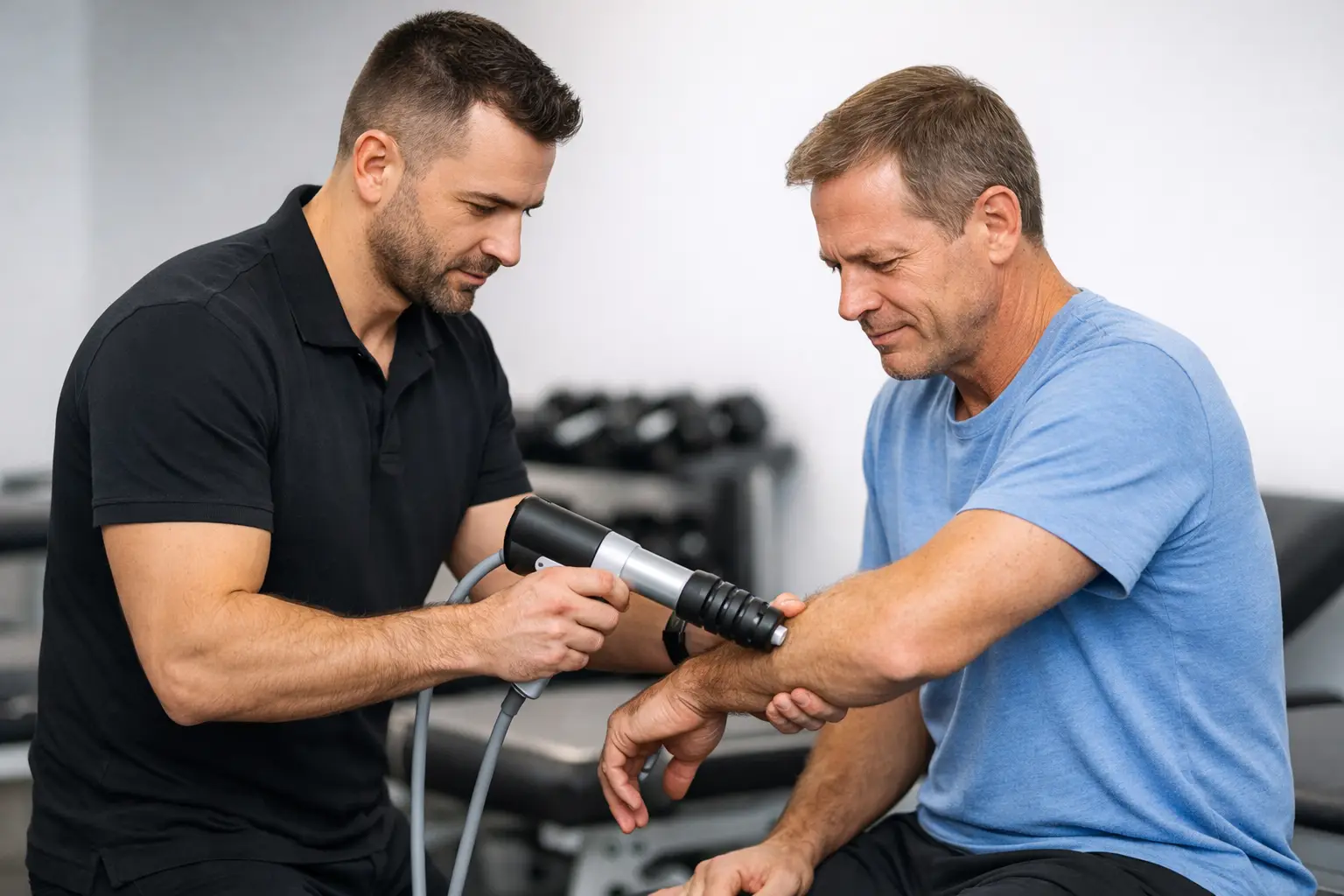
Shockwave therapy and Class IV laser therapy are options that may be considered for some persistent cases of tennis elbow. They are not standalone cures, and they are not necessary for every person. Their potential role is to support pain management and tissue recovery while you follow a progressive loading plan.
The best choice depends on the history of your symptoms, how irritable the area is, what you have already tried, and whether the treatment helps you progress with meaningful activity. Cupping and soft tissue work may also be useful when they provide short-term relief or improve movement tolerance. The key is pairing any modality with a clear rehab progression rather than repeatedly treating the same sore area without changing the underlying demands.
The best treatment plan matches your real life
Generic online exercises can be a reasonable starting point, but tennis elbow does not look identical in every person. A CrossFit athlete struggling with bar work needs a different return-to-training strategy than an electrician working overhead all day. A parent lifting a child, a musician, and an office worker may all have different triggers, recovery windows, and capacity demands.
A thorough assessment should look at when pain started, what movements provoke it, how symptoms behave after activity, your current training or work volume, grip strength, wrist and elbow movement, and the way you perform relevant tasks. It should also account for your target: getting through a workday comfortably is different from returning to heavy deadlifts, competitive tennis, or a full golf season.
At Ground Up Chiropractic and Rehab in Hamilton, care is built around that bigger picture. Chiropractic care, joint mobilization or adjustments when appropriate, soft tissue therapy, shockwave, Class IV laser therapy, and cupping can all have a place. The priority, however, is a detailed movement assessment followed by progressive strength-based rehab and gym-based return-to-performance programming.
That means your plan should evolve. Early on, success may be opening a jar with less pain or working at your desk without a flare-up. Later, it may be rebuilding grip strength, tolerating higher-volume pulling, or returning to a racquet sport with confidence. Progress is not always perfectly linear, but your program should have a reason for each next step.
When to get your elbow assessed
If elbow pain is not improving after a few weeks of sensible load modification, keeps returning whenever you resume activity, or is limiting work, sleep, training, or daily tasks, an assessment can help clarify the next step. It is also worth getting checked if you have significant swelling, a sudden injury with loss of strength, numbness or tingling, pain that does not behave like a typical overuse issue, or symptoms that are steadily worsening.
The goal is not to chase a perfect label. It is to understand what your elbow can currently tolerate, what may be contributing to the flare-up, and how to move forward without guessing.
Your elbow does not need endless rest or another cycle of temporary relief followed by the same flare-up. With the right dose of movement, progressive strength work, and a plan that fits your actual life, you can build back towards lifting, working, playing, and gripping with more confidence. If this sounds like what you are dealing with, book an assessment online and we will help you figure out the best next step.
