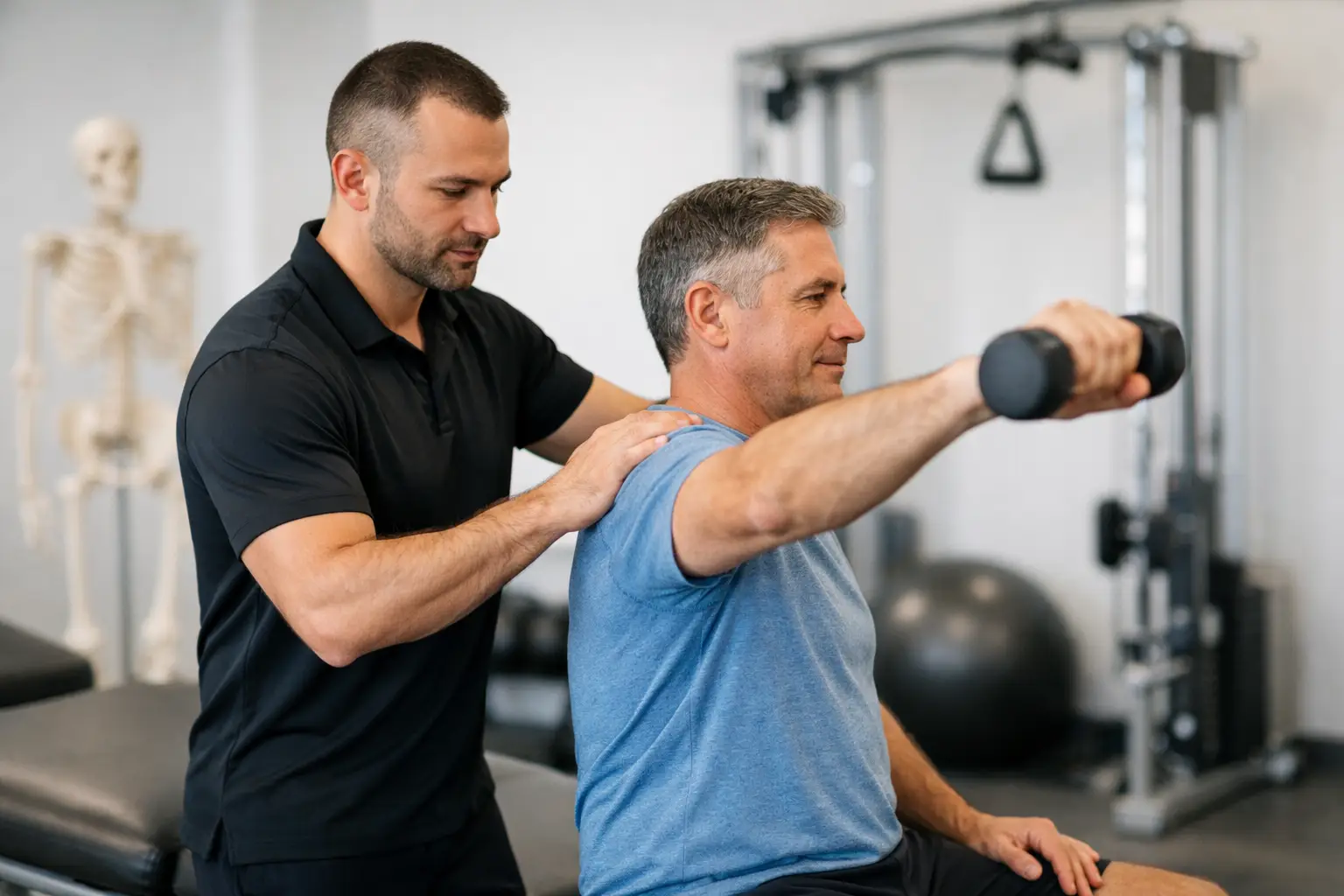
That sharp pinch at the top or front of your shoulder can make a simple overhead reach feel like a bad idea. Pressing in the gym, hanging from a bar, serving in tennis, putting dishes away, or even sleeping on that side may start to feel unpredictable. A good guide to shoulder impingement rehab should not just tell you to stop every painful movement or hand you a band routine. It should help you understand what your shoulder needs to tolerate the activities you want to get back to.
The goal is not to create a perfectly positioned shoulder or avoid overhead movement forever. The goal is to gradually rebuild comfort, control, strength, and confidence so your shoulder can handle training, work, sport, and daily life again.
What “shoulder impingement” actually means
Shoulder impingement is a common label for pain that is often felt at the front or outer side of the shoulder, especially when lifting the arm. You may notice it during a bench press, overhead press, pull-up, lateral raise, throwing motion, or when reaching into the back seat of your car.
The term can be useful as a starting point, but it does not explain the whole story. Shoulder pain is rarely just one structure getting “pinched.” Symptoms can be influenced by recent training volume, irritated rotator cuff tissue, reduced shoulder strength, limited tolerance to overhead positions, neck or upper-back contribution, sleep, stress, and how you move under load.
That is why two people with similar symptoms may need different plans. A CrossFit athlete who developed pain after increasing kipping pull-ups needs a different progression than a desk worker whose shoulder flares after months of reduced activity, or a parent who hurts when lifting a child repeatedly.
Start by changing the load, not stopping all movement
Complete rest can settle symptoms temporarily, but it does not prepare your shoulder for the demands that triggered the problem. At the same time, trying to push through sharp or escalating pain is usually not a useful rehab strategy.
A better middle ground is load modification. Keep moving, but temporarily adjust the exercises, ranges, volume, and intensity that are clearly aggravating the shoulder. If overhead pressing is painful, a landmine press, incline press, lighter dumbbell press, or reduced range may be more tolerable. If a wide-grip pull-up flares symptoms, a supported row or pulldown may let you keep training your upper body while building back capacity.
Some discomfort during rehab can be acceptable, particularly when symptoms are mild and settle shortly after exercise. Pain that becomes sharp, lingers significantly into the next day, or steadily worsens is a sign that the current dose may be too aggressive. Rehab is not about proving toughness. It is about finding a dose your shoulder can adapt to.
A guide to shoulder impingement rehab: what to build
The most effective rehab plans usually address more than one area. The right exercise selection depends on your assessment, but most people benefit from improving shoulder motion, rotator cuff strength, shoulder blade control, and overall pressing or pulling capacity.
Restore comfortable movement first
You do not need unlimited mobility to have a strong shoulder. But if a certain range is stiff, guarded, or painful, gentle, controlled movement can help you regain options. This might include active shoulder flexion, supported arm raises, controlled rotations, or thoracic mobility work when the upper back is contributing to the movement restriction.
The key is to avoid forcing a painful stretch. Aggressively cranking on a sensitive shoulder can make it more reactive. Use a range that feels manageable, move slowly, and build tolerance over time.
Strengthen the rotator cuff
The rotator cuff is a group of muscles that helps control the ball of the shoulder joint during reaching, pressing, pulling, and throwing. It does not need to work in isolation all the time, but targeted work can be useful when pain has reduced your confidence or capacity.
External rotation exercises with a cable, band, or dumbbell are common starting points. Internal rotation, side-lying external rotations, and controlled isometric holds may also fit. The best variation is one you can perform with good control and a manageable symptom response.
Light resistance has a place early on, but staying light forever is not the answer for an active person. As symptoms improve, the cuff needs progressive loading just like any other muscle group.
Train the shoulder blade and upper back
Your shoulder blade provides the foundation for your arm to move and produce force. This does not mean you need to constantly squeeze your shoulder blades down and back. In fact, your shoulder blade should move naturally as your arm lifts overhead.
Rows, chest-supported rows, cable pulls, serratus-focused presses, wall slides, and carries can help develop the muscles that support this control. A good program uses these movements to build strength, not to chase a rigid posture.
Progress pressing and overhead work
Eventually, your shoulder needs exposure to the exact tasks you care about. If your goal is to press overhead, rehab cannot stop at band exercises. You need a gradual path back to overhead strength.
That may start with a more shoulder-friendly angle, such as a landmine press, then move to dumbbell pressing, and later return to barbell work if that suits your goals. For athletes, the progression may also include catching, throwing, hanging, or sport-specific drills. The best exercise is not the one that looks most corrective. It is the one that safely moves you toward your real target.
A practical exercise progression
There is no universal routine, but the following sequence shows how a strength-based plan often develops. Choose exercises based on what your shoulder can currently tolerate and progress only when the response is consistent.
- Early stage: Isometric external rotation, supported rows, comfortable arm raises, and light carries can provide a starting point when the shoulder is irritable.
- Building stage: Cable or dumbbell external rotations, rows, incline pressing, serratus press variations, and controlled pulldowns add more meaningful strength work.
- Return-to-training stage: Dumbbell overhead presses, pull-ups or pulldowns, push-ups, bench press progressions, carries, and sport-specific drills rebuild real-world capacity.
- Performance stage: Heavier pressing, higher-volume training, fast movements, throwing, Olympic lifting, or other goal-specific tasks are reintroduced progressively.
Progress can come from adding resistance, repetitions, range of motion, time under tension, speed, or weekly volume. Change one or two variables at a time. Jumping from pain-free rehab drills to a heavy overhead session is one of the most common reasons symptoms return.
Common mistakes that keep the shoulder irritated
The first mistake is chasing pain relief without rebuilding capacity. Massage, adjustments, joint mobilization, cupping, shockwave therapy, and Class IV laser therapy may help reduce symptoms or make movement more comfortable for some people. But they work best when used as part of a broader plan that includes progressive exercise and a return to the activities that matter to you.
The second mistake is using generic exercises without considering the trigger. A person whose pain began after a sudden spike in bench volume may need training modifications and pressing progressions more than endless mobility drills. Someone with pain during throwing needs a plan that eventually addresses speed, volume, and throwing tolerance.
The third is treating every painful rep as damage. Shoulders can be sensitive, and pain does not always map neatly to tissue injury. At the same time, pain is useful feedback. The answer is not to ignore it or fear it. Use it to guide the dose of training.
Finally, avoid waiting until you are completely pain-free before becoming active again. Long periods of avoidance can reduce strength and make the return feel harder. The right amount of movement often helps restore confidence.
When an assessment makes sense
An in-person assessment is especially valuable if shoulder pain is recurring, has not improved with sensible exercise changes, is limiting work or training, or keeps returning as soon as you resume activity. A clinician can assess shoulder and neck movement, strength, exercise technique, training load, and the demands of your sport or job to identify the most relevant starting point.
Seek timely medical evaluation after a significant fall or trauma, if you have a visible deformity, sudden major weakness, numbness or tingling that persists, fever or unexplained illness, or severe pain that is rapidly worsening. These situations need more than a standard self-directed rehab plan.
At Ground Up Chiropractic and Rehab in Hamilton, care can combine a detailed movement assessment, hands-on treatment when appropriate, chiropractic care, soft tissue therapy, mobility work, and progressive gym-based rehab. The focus is not on collecting passive treatments. It is on building a plan that fits your symptoms, current capacity, and the things you want your shoulder to do.
Your shoulder does not need a perfect exercise or a permanent ban on the movements you enjoy. It needs a clear progression, enough consistency to adapt, and a plan that gives you a reason to trust it again. If this sounds like what you are dealing with, book an assessment online and we will help you figure out the best next step.
