That nagging Achilles after a run, sore elbow during pull-ups, or stiff patellar tendon when you squat is frustrating because it rarely follows a simple timeline. You may feel fine during one workout, sore the next morning, then wonder whether you should rest completely or push through. This guide to tendon pain recovery gives you a more useful middle ground: reduce aggravation where needed, then progressively build the capacity your tendon and body need.
Tendon pain is common in active adults, gym-goers, runners, and people whose work or daily routine involves repetitive loading. It can also affect people returning to activity after a quieter period. The goal is not to find one magic exercise or treatment. It is to understand the pattern, improve how you tolerate load, and return to the things you care about with more confidence.
Why tendon pain can keep hanging around
Tendons connect muscle to bone and transfer force when you walk, lift, jump, grip, throw, or change direction. They are built for load, but they do not always respond well to sudden, repeated, or poorly tolerated increases in load.
That does not mean your tendon is fragile or damaged beyond repair. Tendon pain is more complicated than a single scan finding or a single bad movement. Your symptoms can be influenced by training volume, intensity, sleep, stress, recovery, previous injury, work demands, movement options, and how quickly activity changed.
A runner may develop Achilles pain after adding hills and speed work in the same month. A desk worker may notice elbow pain after taking up climbing, then spending long days on a keyboard. A lifter might tolerate heavy squats for months but flare up when they add more volume, deeper range, and extra conditioning at once. In each case, the issue is often less about one “wrong” exercise and more about a gap between current capacity and current demand.
This is why complete rest can feel helpful at first but disappoint later. Rest may settle symptoms by removing demand. If you return to the same demand without rebuilding tolerance, the pain can return just as quickly.
A guide to tendon pain recovery starts with the right assessment
Not all tendon pain behaves the same way. Location matters, but so do the activities that trigger symptoms, the timing of stiffness, your training history, and the way you move under load. A proper assessment should look beyond the painful spot.
For example, someone with knee tendon pain may need their squat, landing, ankle mobility, hip strength, training schedule, and recovery habits considered. Someone with shoulder or elbow tendon symptoms may benefit from looking at gripping volume, pressing and pulling technique, neck and upper-back movement, and how their workday adds to their total load.
A clinician can also help determine whether the tendon is likely the main source of pain or whether another structure may be involved. New severe pain after a traumatic incident, a visible deformity, major swelling, a sudden loss of strength or function, fever, numbness, or unexplained symptoms deserve prompt medical assessment rather than a self-managed rehab plan.
At Ground Up Chiropractic and Rehab, the assessment is built around your symptoms, movement, lifestyle, and goal. That may be finishing a half marathon, getting back to deadlifts, carrying your child without elbow pain, or simply taking stairs without guarding every step.
Manage load without putting life on pause
The first practical step is identifying the activities that are currently pushing symptoms beyond what you can tolerate. This is not a command to stop all training. It is a chance to adjust the dose.
A useful question is: what can you still do that keeps you active without repeatedly producing a significant flare-up? A runner may temporarily reduce hill repeats while maintaining easy running or cycling. A lifter with patellar tendon pain may modify squat depth, load, tempo, or total sets while continuing to train upper body and posterior chain. For elbow pain, changing grip, reducing high-volume pulling, or using straps for a short period may keep training productive.
Pain during rehab is not automatically harmful, but it should be monitored. Mild, manageable discomfort that settles and does not create a meaningful next-day increase may be acceptable for many people. Sharp pain, escalating pain throughout a session, altered movement because you are protecting the area, or a flare-up that lingers for days are signs the dose may be too high.
The next morning often gives useful feedback. If stiffness or pain is noticeably worse and stays worse after a workout, reduce one variable next time. That could mean fewer sets, less load, slower speed, less range, fewer high-impact sessions, or more recovery between demanding days. Change one or two things, not your entire routine, so you can learn what is helping.
Build tendon capacity with progressive strength work
Tendons generally respond to progressive loading better than endless stretching, random mobility drills, or waiting for pain to disappear. The exact exercise depends on the tendon and the person, but the principle stays consistent: begin with a level you can tolerate, then gradually increase the challenge.
Early rehab may use controlled isometric holds or slower strength exercises when higher-speed movement is too irritable. From there, you may progress through heavier resistance, fuller ranges of motion, single-leg or single-arm work, and eventually energy-storage tasks such as jumping, sprinting, cutting, or sport-specific drills when relevant.
For Achilles pain, that might mean progressing calf work from supported raises to heavier straight- and bent-knee variations, then eventually hopping and running exposure. For patellar tendon pain, it may include squat or split-squat progressions before introducing more demanding jumping and deceleration. For tendon pain around the shoulder or elbow, the plan may build grip, rotator cuff, pulling, pressing, and overhead tolerance in stages.
The best program is not necessarily the most complicated. It is one you can perform consistently, progress appropriately, and connect to your real goal. If you want to return to tennis, your recovery cannot stop at a band exercise. It needs to prepare you for serving, gripping, reaching, decelerating, and playing for the duration you actually want to play.
Hands-on treatment can help, but it is not the whole plan
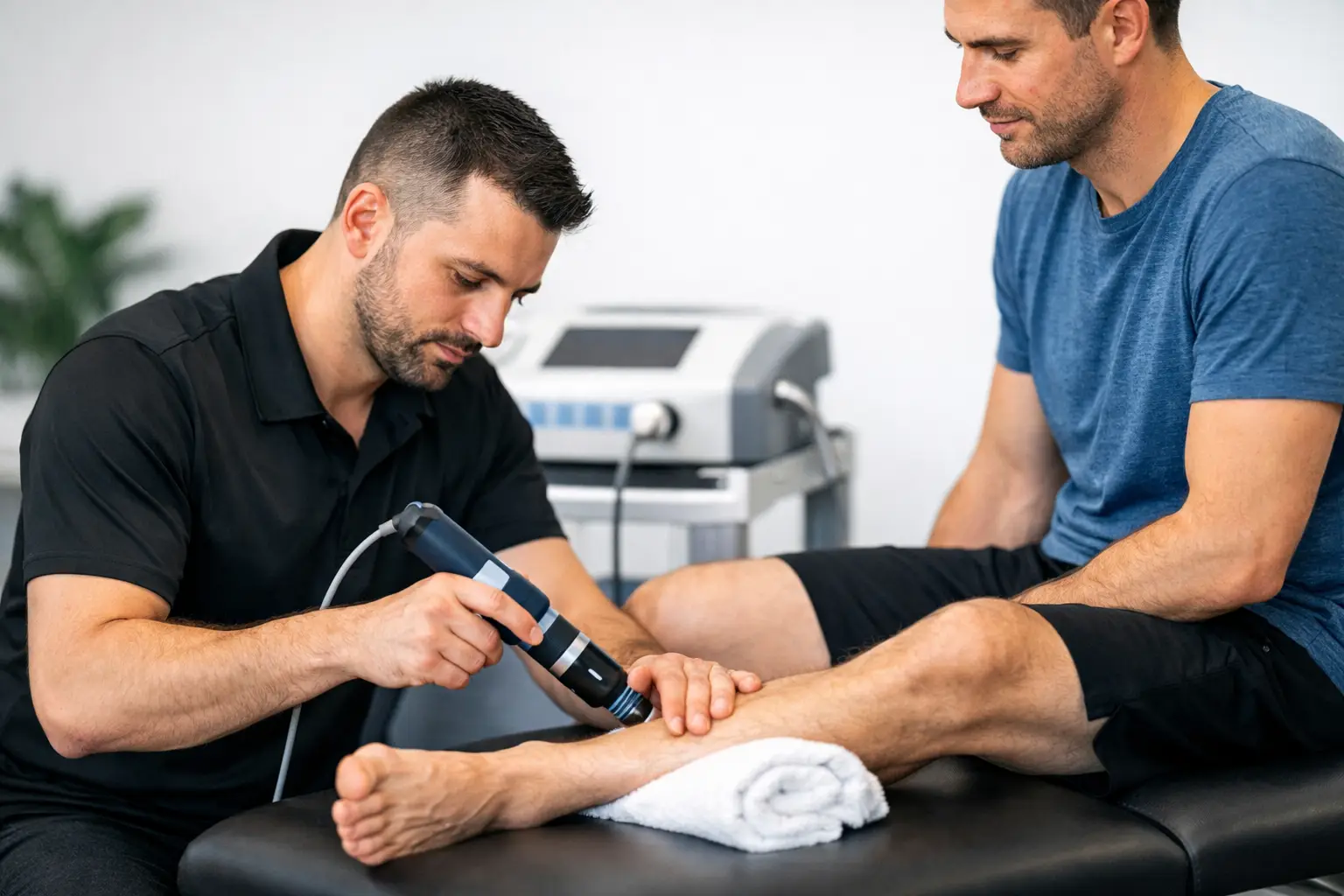
Manual therapy, soft tissue work, joint mobilization, chiropractic treatment, massage therapy, cupping, shockwave therapy, or Class IV laser therapy may help reduce symptoms or improve movement tolerance for some people. Used appropriately, these tools can make it easier to begin or progress the work that matters.
They are not substitutes for rebuilding capacity. If treatment only makes you feel better for a day but does not change what you can tolerate in training, work, or sport, the plan is incomplete. A better approach combines hands-on care when it fits with clear exercise progressions, practical load management, and a return-to-performance strategy.
That balance matters because recovery is not always linear. A flare-up does not automatically mean you have undone all your progress. It may simply mean that the recent dose exceeded your current tolerance. The answer is usually to reassess, adjust, and continue building, not to abandon movement altogether.
Return to training with a plan, not a test
Many people feel better during ordinary daily activity but get caught out when they jump straight back into their old workout, race pace, or sport schedule. Feeling less pain is a positive sign, but it is not always the same as being ready for your previous workload.
Return gradually by rebuilding the demands that matter most. If you are a runner, consider total distance, pace, hills, terrain, and frequency. If you lift, consider intensity, volume, exercise selection, range, and fatigue. If you play a sport, consider sprinting, jumping, contact, practice length, and how often you compete.
This is where gym-based rehab is valuable. It creates a controlled bridge between basic exercises and the real-world demands of training, work, and sport. You are not just trying to make a sore tendon quiet. You are proving, step by step, that your body can handle more.
Tendon recovery rewards patience, but it should not feel vague. With a clear assessment, a manageable training dose, and progressive strength work, you can move from constantly protecting the painful area to trusting it again. If you are stuck in repeated flare-ups or unsure how to progress, book an assessment and get a plan built around the life and training you want to return to.
