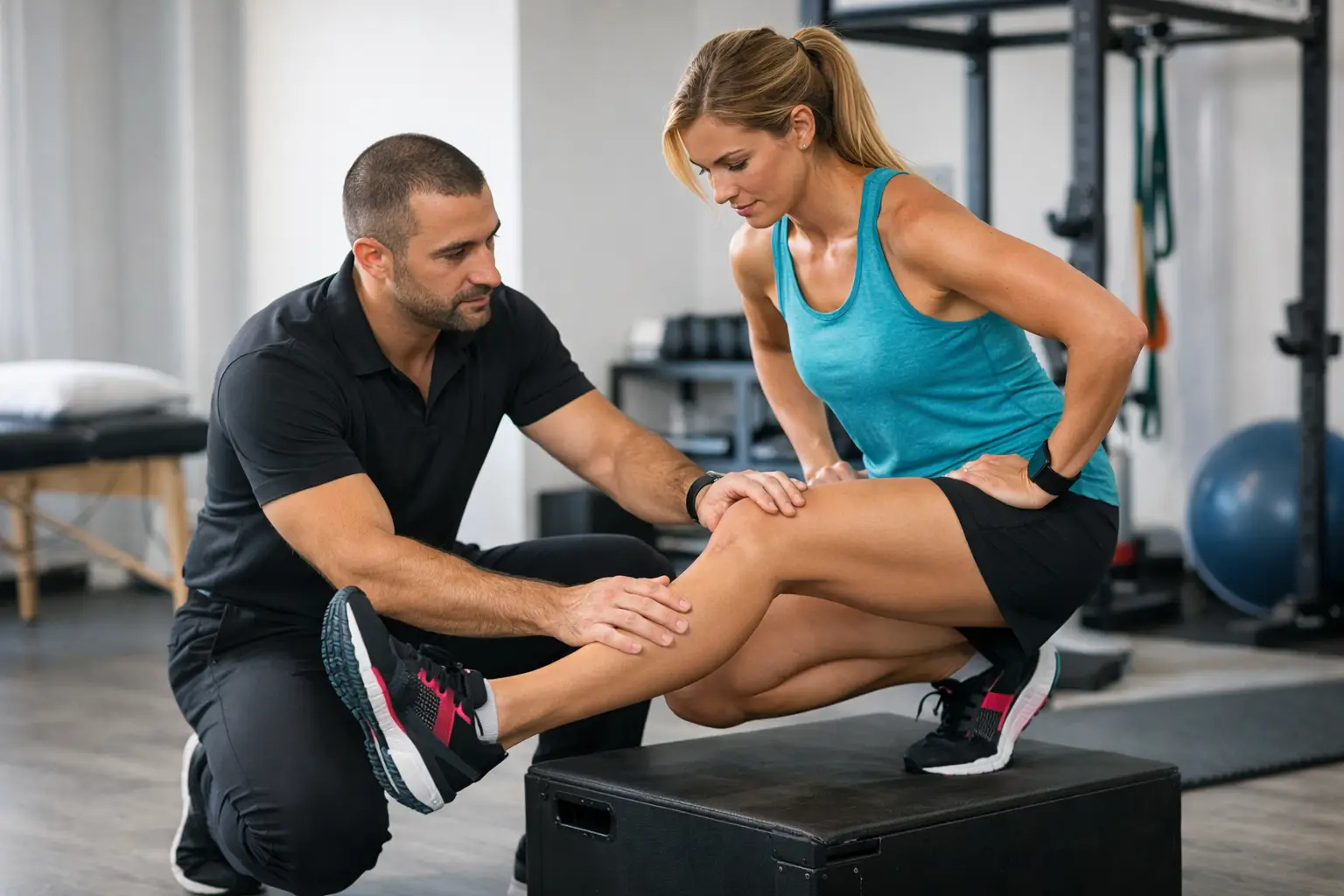
A runner cuts mileage, buys new shoes, stretches more, maybe even stops running for a couple of weeks - and the knee still flares up as soon as training picks back up. That pattern is exactly why knee rehab for runners needs to be more than rest, foam rolling, or a sheet of generic exercises. If the knee keeps getting irritated, there is usually a loading problem, a strength problem, a movement problem, or some combination of all three.
The good news is that most running-related knee issues respond well to the right rehab approach. The less helpful news is that the right approach is rarely just about the knee.
Why runners get stuck in the rehab loop
A lot of runners do what seems logical. They back off when pain spikes, wait until it settles, then return to normal training as quickly as possible. The trouble is that pain calming down does not always mean the tissues are ready for the same workload again.
That is where rehab often breaks down. If you do not rebuild strength, restore tolerance to impact, and address the factors that made the knee unhappy in the first place, the same symptoms tend to come back at the same pace, the same hill session, or the same long run.
This is also why passive care alone can feel good but not hold. Hands-on treatment, chiropractic care, soft tissue work, massage therapy, mobility drills, cupping, shockwave therapy, or Class IV laser therapy may help reduce irritation and improve comfort. But for runners, symptom relief is only one part of the job. Capacity has to improve too.
What knee rehab for runners should actually target
Most runners think pain location tells the whole story. Sometimes it helps, but it does not tell you why the problem is happening. Pain around the kneecap, along the outside of the knee, below the kneecap, or around the joint line can all show up when training load exceeds what the system can currently handle.
That system includes the foot and ankle, the calf, the quads, the hamstrings, the hips, and the trunk. It also includes training variables like pace, volume, frequency, terrain, sleep, stress, and recovery. If your rehab ignores those pieces, you may feel temporarily better without becoming more durable.
Good knee rehab for runners usually focuses on three things at once: settling symptoms enough that you can move well, building strength in the tissues that need to absorb force, and progressing back to running in a way your body can tolerate.
The first goal is not complete rest
There are times when a short reduction in running is the right call, especially if pain is worsening quickly, altering your gait, or lingering for days after each run. But complete shutdown is not automatically the best answer.
In many cases, the better move is to modify rather than stop. That might mean shorter runs, flatter routes, slower paces, fewer downhill efforts, or replacing some running sessions with lower-impact conditioning while you build capacity. Keeping some level of tolerated movement often helps runners stay stronger, less stiff, and more confident during recovery.
This is where an assessment matters. The right amount of loading depends on how irritable the knee is, what structures are involved, and what your current training demands look like.
Strength matters more than most runners think
If you run a lot, it is easy to assume running itself should be enough to prepare your legs for running. It is not. Running builds a certain kind of endurance, but recurring knee pain often shows up when a runner lacks the strength or control to handle repeated impact efficiently.
That does not mean every runner needs to squat heavy right away. It means rehab should progressively improve the ability of the quads, calves, glutes, hamstrings, and supporting trunk muscles to manage force.
Start with what the knee can tolerate
Early-stage rehab may include simpler movements like split squat holds, step-ups, controlled sit-to-stands, calf raises, bridge variations, or isometric quad work. These are not flashy, but they are useful when pain is still reactive.
If the knee is highly irritated, isometrics can help reduce pain sensitivity while keeping the area loaded. As tolerance improves, rehab can move toward deeper knee flexion work, single-leg strength, deceleration drills, and eventually more elastic and plyometric loading.
Progressions matter more than exercise selection alone
There is no magic exercise for runners' knees. The best exercise is the one that matches your current tolerance and moves you toward the demands of running.
For one runner, that might mean building from bodyweight split squats to loaded rear-foot elevated split squats. For another, it may mean restoring calf strength and ankle stiffness so the knee stops taking more load than it should. For a runner returning to speedwork, hopping, bounding, and change-of-pace drills may be just as important as traditional strength work.
Running form can matter, but it is not always the first fix
Runners often ask whether their knee pain is a gait issue. Sometimes yes, sometimes not really. Form can influence how load is distributed through the lower body, but trying to force technical changes without addressing strength and workload is usually incomplete.
A small stride adjustment, cadence change, or cue to reduce overstriding can be helpful in some cases. But if your tissues are underprepared for your training demands, better mechanics alone will not solve the whole problem.
This is another reason a movement-based rehab plan works better than isolated treatment. The question is not just, "What does your run look like?" The question is, "What can your body currently handle, and what does it need to get back to your goals?"
How a complete rehab plan often looks
A solid rehab process usually starts with a detailed look at symptoms, training history, irritability, strength, mobility, and movement patterns. From there, treatment is built around what is limiting progress.
For some runners, hands-on care helps calm things down enough to tolerate exercise better. Joint mobilization, soft tissue treatment, chiropractic adjustments when appropriate, or massage therapy may help improve short-term comfort and movement quality. Tools like shockwave therapy or Class IV laser therapy can also be useful in the right case, especially when they support a broader plan instead of replacing it.
The bigger piece is progressive rehab. That means building from pain-limited strength work into more demanding single-leg patterns, impact tolerance, and eventually gym-based return-to-performance work that reflects real running demands. If you want to get back to hills, tempos, races, or longer mileage, your rehab should prepare you for those things - not just get you through daily activities.
At Ground Up in Hamilton, that is the difference. The goal is not to chase temporary relief. The goal is to figure out why the knee keeps getting overloaded, improve how you move, and build the strength and confidence to return to training properly.
When runners return too early
A common mistake is using pain at rest as the main green light. A knee that feels fine walking around may still not be ready for intervals, hills, or a jump back to pre-injury volume.
Return-to-run decisions should consider more than whether symptoms are gone on the couch. Can you tolerate single-leg loading well? Has your strength improved side to side? Can you handle hopping or other impact drills without a symptom spike? Are your runs staying predictable during and after training?
Some discomfort during rehab is not always a sign you are causing damage, but the response matters. If pain is sharply worsening, changing your running pattern, or lingering and escalating after each session, the progression likely needs to be adjusted.
Signs you need a more individualized plan
If you have already tried rest, stretching, band exercises from social media, massage, or occasional treatment but the pain keeps cycling back, that is usually a sign you need a more specific plan. The same goes for runners who can jog a little but cannot rebuild speed, distance, hills, or consistency.
A more complete assessment can help identify whether the issue is mainly tendon irritability, patellofemoral loading, reduced ankle contribution, poor single-leg control, strength deficits, training error, or a mix of several factors. That level of detail changes rehab.
It is also worth getting assessed sooner if the knee is locking, giving way, swelling significantly, or if pain followed a more traumatic event. Not every knee issue is a simple overuse problem.
What better rehab should feel like
It should feel structured. You should understand what is being worked on, why certain movements matter, and how your running will be modified and progressed. You should know whether the goal right now is symptom control, strength building, impact prep, or return to performance.
Most of all, it should feel like you are moving forward, not just managing flare-ups. Runners do best when rehab respects the fact that they do not just want less pain. They want to train, race, stay active, and trust their body again.
If your knee has been deciding how much you can run, there is usually a better path than waiting it out and hoping the next break fixes it. The right rehab plan builds a stronger runner, not just a quieter knee.
