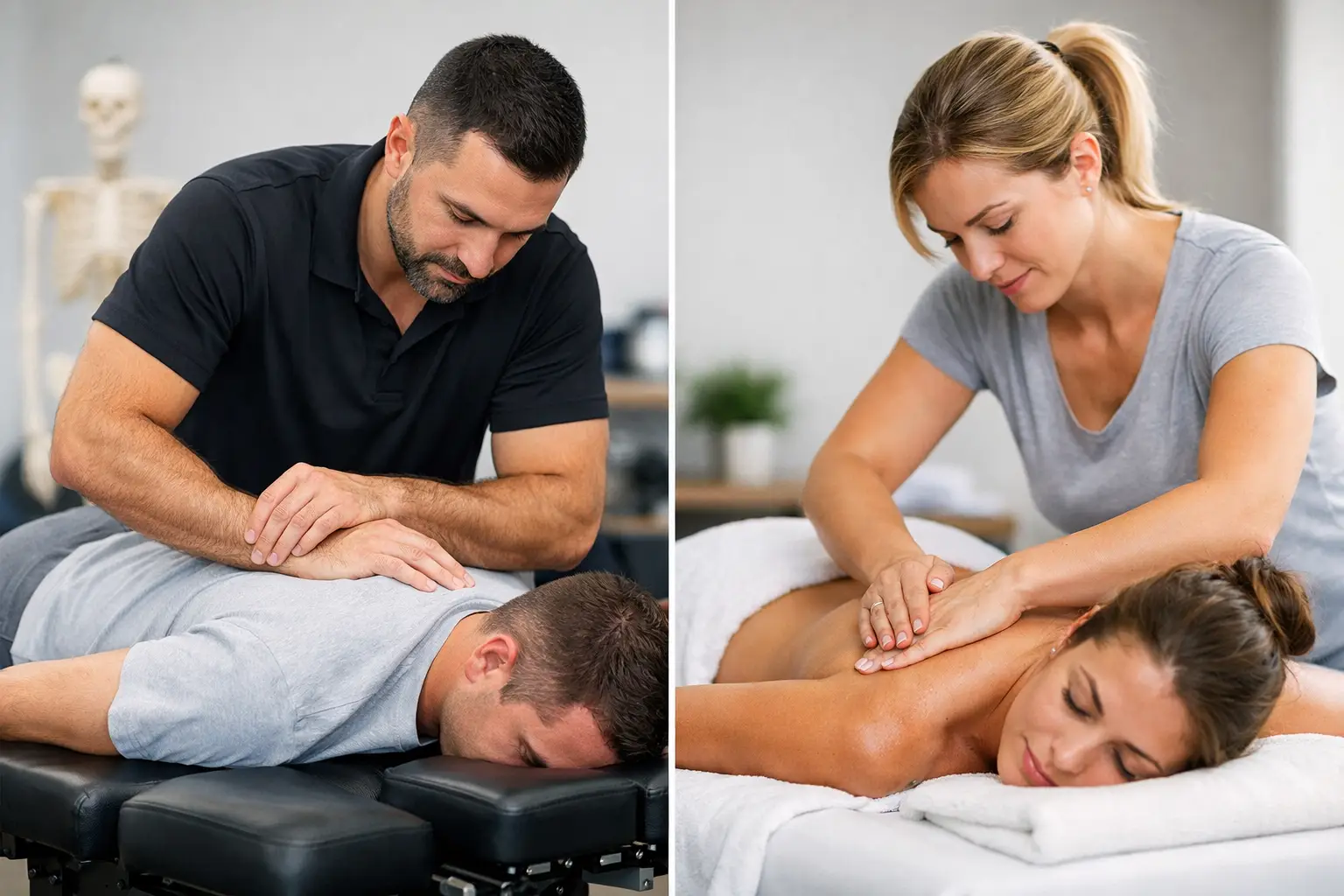
That tight neck, stubborn low back flare-up, or hip that keeps barking during squats usually leads to the same question: massage therapy vs chiropractic - which one should you book? The honest answer is that they do different jobs, and the right choice depends on why you hurt, how you move, and what you actually want to get back to.
If your goal is simply to feel looser for a day or two, that is one conversation. If your goal is to train, work, run, lift, golf, or get through long desk days with fewer setbacks, that is a different one. Most people do not need a debate. They need the right tool, at the right time, as part of a plan that makes sense.
Massage therapy vs chiropractic: what is the difference?
Massage therapy is primarily focused on soft tissue. That means muscles, fascia, and other surrounding tissues that can feel tight, sensitive, overworked, or guarded. A registered massage therapist may use techniques aimed at reducing tension, improving comfort, and helping you relax or move with less restriction.
Chiropractic care is broader than many people assume. Yes, it can include joint adjustments when appropriate, but good chiropractic care should also look at how your joints move, how your body loads, where you are losing mobility or control, and what movement strategies may be contributing to the problem. In a rehab setting, chiropractic is not just about cracking joints. It is about assessing movement, reducing irritation, restoring function, and building a path back to activity.
That distinction matters. If your calves are tight after a hard race block, massage may be the most direct option. If your low back pain keeps returning every time you deadlift because your hip mobility, trunk control, and load management are off, hands-on treatment alone probably will not solve the full problem.
When massage therapy makes sense
Massage therapy can be a great fit when soft tissue sensitivity is the main issue. Maybe your upper traps and neck are lit up after a stressful work week. Maybe your quads feel cooked after returning to running too quickly. Maybe you just feel stiff, compressed, and beat up.
In those cases, massage can help calm things down. It often improves short-term comfort, reduces the feeling of tightness, and gives you a window where movement feels easier. That can be valuable, especially for active adults who need to recover between training sessions or manage the physical load of work and life.
But there is a trade-off. Massage usually does not address the full reason symptoms keep returning. If your shoulder keeps tightening up because your thoracic mobility is poor, your training volume jumped fast, and your pressing mechanics are off, tissue work may help the symptom without changing the pattern behind it.
That does not make massage therapy less useful. It just means its best role is often part of a bigger strategy, not the entire strategy.
When chiropractic care makes sense
Chiropractic care tends to make more sense when joint movement, mechanics, pain with specific positions, or recurring flare-ups are part of the picture. A good example is the person whose neck locks up when checking blind spots, or the lifter whose back pain shows up every time they hinge, rotate, or brace under load.
The value of chiropractic in a rehab-focused setting is that it can combine several things at once. You might need joint mobilization or an adjustment to help a stiff area move better. You might also need soft tissue treatment, mobility drills, exercise progressions, and coaching around how to load that area again without feeding the same cycle.
This is where a lot of people get stuck with traditional passive care. They feel better after treatment, but nothing changes in the way they move, train, recover, or build capacity. So the relief is real, but temporary. If your body cannot tolerate the demands you place on it, symptoms usually come back.
Massage therapy vs chiropractic for back pain, neck pain, and headaches
This is where context matters most.
For back pain, massage therapy may help if the area feels guarded, tense, and irritated after a long week, hard workout, or poor sleep. Chiropractic may be more useful if certain movements are limited, the pain is clearly aggravated by bending or twisting, or there is a pattern of repeated flare-ups tied to movement and loading.
For neck pain, massage can be excellent for muscle tension, stress-related tightness, and postural discomfort. Chiropractic can help when neck motion feels restricted, symptoms are mechanical, or the issue is tied to how the upper back, shoulders, and neck work together.
For some headaches, both can play a role. If muscle tension around the neck, jaw, or upper traps is contributing, massage may help. If joint stiffness, posture, or neck mechanics are part of the picture, chiropractic may be useful. Persistent, severe, unusual, or changing headaches should always be assessed properly by a qualified healthcare professional.
There is no universal winner here. The better question is not which profession is best. It is what is driving your symptoms, and what combination of care gives you the best chance of lasting improvement.
Why one treatment alone is often not enough
A lot of active adults have already tried the one-thing approach. Maybe they got massage every few weeks and felt great for 48 hours. Maybe they had repeated adjustments that helped, but the same pain kept returning when they trained hard or sat too long. Maybe they were given a sheet of generic exercises that did not match their actual problem.
Pain is rarely just about one tight muscle or one stiff joint. It is often a mix of tissue sensitivity, movement restriction, strength deficits, training errors, recovery issues, old injuries, workload spikes, and habits that overload the same area again and again.
That is why the best care plans tend to be layered. Hands-on treatment can reduce pain and improve movement enough for you to start moving better. Rehab can build the strength, control, and tolerance needed to keep progressing. Education helps you understand why the issue keeps showing up and what to change.
In a rehab and performance clinic, massage therapy and chiropractic should not compete with each other. They should work together when needed.
How to choose the right starting point
If you mainly feel muscular tension, soreness, stress-related tightness, or general stiffness, massage therapy may be the right place to start. If you are dealing with repeated movement-related pain, joint restriction, or an injury that keeps affecting training, chiropractic assessment may be the better first step.
If you are not sure, that is normal. Most people are not expected to know whether their issue is coming more from soft tissue, joint mechanics, mobility loss, strength deficits, or some combination of all four. That is exactly why assessment matters.
A strong assessment should look at your symptoms, movement quality, activity demands, injury history, and goals. It should answer practical questions. What seems to be driving the problem? What helps in the short term? What needs to change for long-term progress? What should treatment look like over the next few weeks?
Those answers are far more useful than being told one profession is always better than another.
What better care looks like
The most useful treatment model for active people is not passive-only care. It is care that meets you where you are, helps you calm symptoms down, and then builds you back up.
That may include massage therapy to reduce muscle tone and sensitivity. It may include chiropractic treatment, joint mobilization, or adjustments when they fit the presentation. It may include shockwave therapy, Class IV laser therapy, cupping, mobility work, and exercise progressions. Most importantly, it should include a clear rehab plan that helps you return to lifting, running, sport, work, or daily life with more confidence.
That is the difference between chasing relief and building resilience. Relief matters. No one performs well when they are in pain. But if treatment stops there, you are often left managing the same issue instead of moving past it.
At Ground Up Chiropractic & Rehab in Hamilton, that is why care is built around more than one tool. The goal is not to push massage or chiropractic as a winner. The goal is to figure out what your body needs, use the right combination of treatment and rehab, and help you get back to doing what you actually care about.
If you are weighing massage therapy vs chiropractic, do not just ask which one feels good faster. Ask which approach gives you a better chance of moving well, handling load, and staying active with fewer setbacks. That is usually where real progress starts.
