You squat, run, sit at a desk, pick up your kids, or train hard all week - and the same pain keeps showing up. Maybe your back tightens every time deadlifts get heavy. Maybe your shoulder pinches when you press overhead. Maybe your knee behaves for a while, then flares up again as soon as activity picks back up. That is exactly where movement assessment for pain matters.
A lot of people have already tried something before they book an appointment. Rest. Massage. Adjustments. Stretching. A few exercises they found online. Sometimes those things help for a bit. But if nobody has looked closely at how you move, what aggravates your symptoms, what you are currently able to tolerate, and what your goals actually are, it is easy to miss the bigger picture.
Pain is not always just about one tissue being irritated. It can also be about load tolerance, mobility restrictions, strength deficits, movement habits, recovery, training volume, work demands, and confidence. That does not mean every painful movement is dangerous. It means the right rehab plan should be built around what your body is doing now and what it needs to handle next.
What a movement assessment for pain actually looks at
A good assessment is not a performance test for perfect posture or textbook movement. It is a practical way to understand which movements are limited, which ones reproduce symptoms, and which ones feel better with the right changes.
That usually starts with your story. Where is the pain? When did it start? Was there a clear injury or did it build gradually? What makes it worse? What helps? Are you trying to get back to lifting, running, golf, work, or simply getting through the day without constant stiffness?
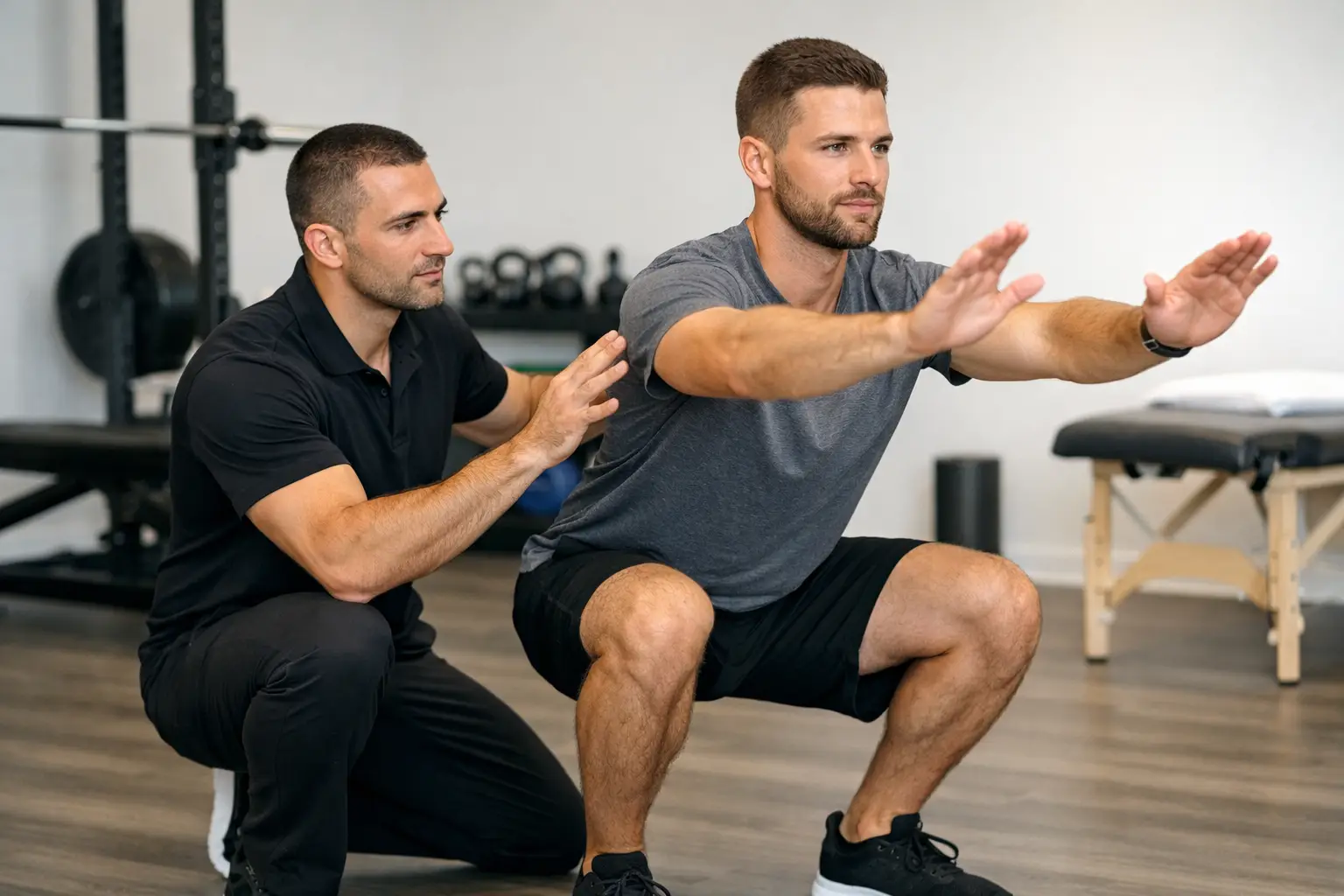
From there, the assessment looks at how you move in real tasks. Depending on the issue, that might include a squat, hinge, lunge, step-up, overhead reach, push, pull, rotation, walking pattern, or getting on and off the floor. It may also include checking joint range of motion, muscle strength, balance, coordination, and symptom response with specific positions or loads.
The goal is not to label you as broken. The goal is to find useful patterns. If your low back pain appears every time you bend under load, that matters. If your shoulder feels better when your ribcage and upper back move better, that matters too. If your knee pain spikes during stairs but settles when hip strength and control improve, that gives us something we can work with.
Why movement assessment for pain is more useful than guessing
When treatment is based on guesswork, people often end up bouncing between short-term fixes. They get temporary relief, then hit the same wall again. That cycle is frustrating, especially for active adults who do not want to keep taking time off from training, work, or sport.
A movement assessment gives context to the pain. It helps answer questions like: Is the issue mostly irritability right now, meaning the area needs to calm down first? Is the bigger problem that you have lost strength, mobility, or confidence after weeks of avoiding movement? Are your symptoms tied to one specific task, or do they show up because your overall workload is too high for your current capacity?
Those details change the plan.
For one person, the right first step may be hands-on treatment, a few movement modifications, and a gradual return to loading. For another, it may be less about treatment tables and more about rebuilding tolerance through progressive exercise. For someone else, the answer might be a combination: chiropractic care, soft tissue work, mobility drills, and strength progressions that carry over into the gym.
That is why assessment matters more than chasing the same treatment over and over.
Pain and movement are connected, but not always in a simple way
One of the biggest mistakes people make is assuming pain automatically points to one exact cause. Sometimes it does. Often, it does not.
You can have a stiff hip and no pain. You can have pain with decent mobility. You can move in a way that looks unusual but functions well. You can also have a technically decent squat and still get pain because your current load, volume, recovery, or tissue tolerance is off.
This is where nuance matters. A movement assessment for pain is not about blaming your pain on one crooked movement pattern or one weak muscle. It is about identifying the factors that seem most relevant for you.
That might include joint stiffness, reduced control through a range, poor tolerance to impact, loss of strength after time off, or simply doing too much too soon. Sometimes the issue is local. Sometimes it is the way the whole system handles stress. Most of the time, it is some mix of both.
What happens after the assessment
The best assessment is the one that leads to a clear plan.
If your pain is highly irritable, the early phase may focus on reducing symptoms enough that you can start moving more comfortably. That can include chiropractic treatment, joint mobilization or adjustments when appropriate, soft tissue therapy, cupping, shockwave therapy, Class IV laser therapy, or massage therapy as part of a bigger strategy. These tools can help create a window for better movement, but they are not the whole plan.
Once symptoms are more manageable, rehab needs to build capacity. That may mean relearning a hinge pattern, improving ankle or thoracic mobility, strengthening the glutes and trunk, or gradually reintroducing pressing, squatting, running, or rotational work. The key is progression. If exercises stay too easy for too long, they stop preparing you for real life. If they progress too aggressively, symptoms can flare.
That middle ground is where good rehab lives.
At Ground Up Chiropractic and Rehab in Hamilton, that process is built around what you actually need to return to. For some people, that is being able to sit, drive, and sleep without pain. For others, it is getting back under a barbell, preparing for a race, or feeling confident enough to swing a golf club without guarding every movement. The assessment helps decide which treatments fit, which exercises matter most, and how to progress them.
Why active adults often need more than passive care
Passive care has a place. Hands-on treatment can help reduce symptoms, improve comfort, and make movement easier in the short term. But if recurring pain is tied to how much load you can tolerate, how well you control movement, or how confidently you return to activity, passive care alone usually is not enough.
That is where many people get stuck. They feel a bit better after treatment, then go right back to the same pattern with no real plan for rebuilding strength or tolerance. A week or two later, the pain returns and the cycle starts again.
A better approach is to use symptom relief as a starting point, not the finish line. If your shoulder is less painful after treatment, great. Now we can work on why pressing, reaching, or pulling has been a problem. If your low back loosens up, good. Now we can rebuild your hinge, trunk strength, and tolerance to lifting.
That shift matters because the real goal is not just less pain today. It is more options tomorrow.
What a good rehab plan should feel like
You should leave an assessment understanding more than you did when you walked in. Not with a lecture, and not with a vague list of stretches, but with a clear sense of what is likely driving the problem and what the next steps look like.
That plan should feel specific to your life. A runner needs something different than a powerlifter. A desk worker with neck tension needs a different strategy than a parent whose back flares up lifting a toddler. Even two people with the same body part pain may need completely different rehab based on their movement patterns, goals, schedule, and symptom behaviour.
You also want a plan that can adapt. Some weeks you may progress quickly. Other weeks your sleep, stress, workload, or training volume may affect recovery. Good rehab accounts for that instead of pretending progress is always linear.
Most importantly, you should feel like movement is becoming less confusing. When people understand what aggravates symptoms, what helps, and how to load the body gradually, they tend to move with more confidence. That confidence is part of recovery too.
If pain keeps interrupting training, work, or everyday life, guessing is rarely the best strategy. A detailed movement assessment for pain can help connect the symptoms to the bigger picture, so treatment and rehab actually move in the right direction. And when the plan fits your body, your goals, and your activity level, getting back to the things you care about starts to feel a lot more realistic.
