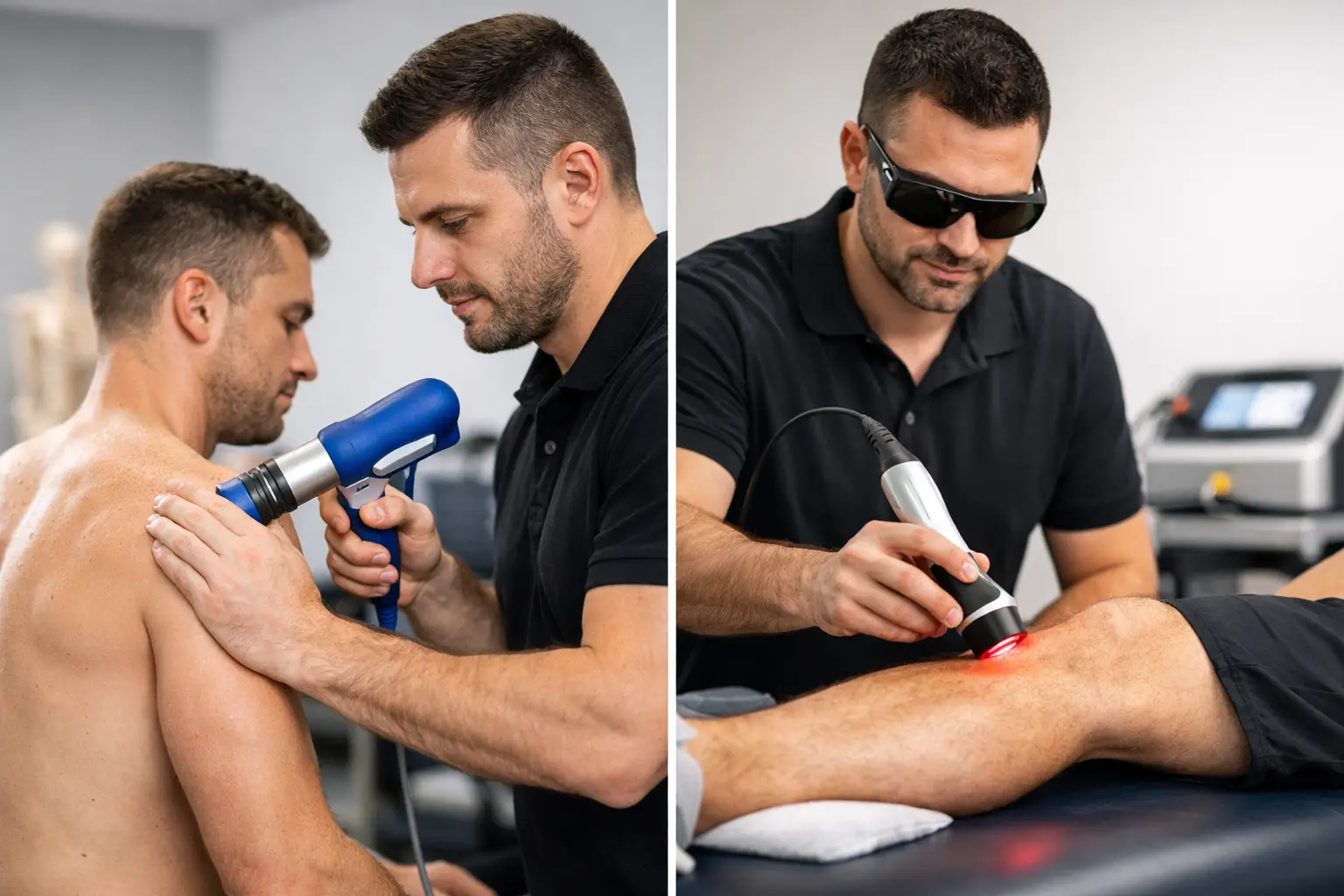
A sore Achilles that keeps flaring after runs. Elbow pain every time you grip a barbell. A shoulder that feels fine until pressing day. These problems often lead people to ask about shockwave therapy vs laser therapy - and whether one is the faster answer.
The honest answer is that neither treatment is a standalone fix. Both can be useful tools for certain pain presentations, particularly stubborn tendon, muscle, and joint-related issues. But the best choice depends on what is irritated, how long it has been happening, how you move, what you need your body to do, and what your rehab plan is missing.
At Ground Up Chiropractic and Rehab, we use treatment tools to support a bigger goal: helping you build the capacity and confidence to return to training, work, sport, and daily life.
Shockwave Therapy vs Laser Therapy: The Main Difference
Shockwave therapy uses acoustic pressure waves delivered to a targeted area. It is commonly used in rehab settings for persistent tendon pain and certain soft-tissue conditions. The treatment is typically noticeable during the session. Some people describe it as intense but manageable, especially when the tissue is sensitive.
Class IV laser therapy uses focused light energy to deliver heat and stimulation to tissues. It is generally comfortable, although you may feel warmth in the area being treated. Laser is often used when the goal is to help settle pain and irritability, support circulation, and make movement or exercise more tolerable.
The simplest distinction is this: shockwave is often considered when a stubborn, longer-standing tendon or soft-tissue problem needs a focused loading stimulus. Laser may be a better fit when a painful or reactive area needs help calming down so you can start moving more comfortably. That is a general pattern, not a rule.
Neither option replaces a proper assessment. Pain in the same location can come from very different movement, loading, or tissue issues. Two people with “shoulder pain,” for example, may need completely different plans.
When Shockwave Therapy May Be Useful
Shockwave therapy is most often discussed for persistent tendon-related pain. Common examples include Achilles tendinopathy, plantar heel pain, tennis elbow, golfer’s elbow, patellar tendon pain, and some hip-related tendon conditions.
These issues can be frustrating because rest alone often does not solve them. You may stop running, lifting, or playing your sport for a few weeks, feel slightly better, then flare up when you return to normal activity. That cycle usually means the tissue and surrounding system have not regained enough capacity for the demands you are placing on them.
Shockwave may help as part of a plan when pain has been hanging around, progress has stalled, and the clinical presentation fits. It is not meant to “break up scar tissue” or force a damaged tendon to heal overnight. Those explanations are too simplistic. Instead, it may help influence pain and tissue response while you progressively rebuild tolerance through the right exercises.
A runner with ongoing Achilles pain, for instance, may benefit from shockwave alongside calf-strength work, running-load adjustments, ankle and hip movement assessment, and a gradual return-to-run progression. Using shockwave without addressing those pieces can leave the original overload pattern untouched.
What to expect after shockwave
Some tenderness or short-term soreness can occur after treatment, particularly in already sensitive tissue. Your clinician should explain how to manage activity around your sessions and how treatment fits with your training plan.
The right response is not always complete rest. In many cases, the better approach is to modify load intelligently: reduce what aggravates symptoms, keep what is tolerable, and progressively earn your way back to higher-demand activity.
When Class IV Laser Therapy May Be Useful
Class IV laser therapy may be useful when pain is limiting movement, sleep, training, or early-stage rehabilitation. It can be considered for a range of muscle, tendon, and joint-related concerns, including acute flare-ups, strains, irritated tendons, shoulder pain, neck or back pain, and painful joint conditions.
For an active person, laser can be valuable when it helps create a window to move. If your low back is too irritated to tolerate basic hip-hinge practice, or your shoulder is too reactive to begin pressing progressions, reducing symptoms enough to start appropriate rehab matters.
That does not mean laser is only for recent injuries. Some longer-term issues stay highly irritable, especially when work demands, poor sleep, sudden training spikes, or repeated aggravating movements keep the system wound up. In those cases, laser may be used to support hands-on treatment and exercise while you rebuild control and strength.
Laser is usually a lower-intensity experience than shockwave from the patient’s perspective. It may be a practical option for people who are very sensitive to touch or who are not ready for a more provocative treatment approach.
Which One Works Better for Tendon Pain?
For persistent tendon pain, shockwave is often the more commonly considered option, but it is not automatically the better one. The answer depends on whether the condition actually behaves like a tendinopathy, how irritable it is, the location involved, your health history, and what has already been tried.
A tendon that hurts only during high-load activity may need a different strategy than one that is painful during walking, sitting, gripping a coffee mug, or sleeping. The first person may be ready for a more focused strength progression. The second may need a period of symptom reduction, load modification, and lower-level exercise before higher-intensity work makes sense.
Laser may still be helpful for tendon pain when irritability is high or when pain is preventing progress. Shockwave may be considered when the presentation and timeline fit. In both cases, progressive loading remains central. Tendons adapt to appropriately dosed force, not to passive treatment alone.
The Treatment Tool Matters Less Than the Plan Around It
It is easy to focus on the machine because it feels like a clear decision: shockwave or laser. The more important question is whether your care plan identifies why the problem keeps showing up.
That might include a sudden increase in running volume, weak or undertrained calves, poor tolerance to pressing volume, limited hip control, a work setup that keeps aggravating your neck, or a mismatch between your recovery and your training demands. Pain is rarely explained by one factor alone.
A rehab-focused plan may combine chiropractic care, joint mobilization or adjustments when appropriate, soft tissue therapy, massage therapy, cupping, shockwave or Class IV laser therapy, and mobility work. But those options should support the active part of recovery: graded exposure, strength development, movement practice, and a realistic return-to-performance plan.
For the desk worker with recurring neck pain, that may mean improving upper-back movement, building pulling strength, changing how breaks are used through the day, and gradually returning to the gym. For the CrossFit athlete with elbow pain, it may mean modifying pulling volume, improving grip and forearm capacity, and progressing back to bar work without guessing.
What Happens in a Good Assessment
A useful assessment should go beyond locating the painful spot. Your clinician should ask how symptoms started, what reliably aggravates or eases them, what training or work demands matter most, and what you have already tried.
They should also assess relevant movement, strength, range of motion, and tolerance to load. This helps determine whether shockwave, laser, another hands-on option, exercise-based rehab, or a combination is appropriate. Sometimes the best choice is neither modality at that visit.
If symptoms are severe, unusual, associated with significant trauma, or accompanied by concerning changes such as unexplained weakness, numbness, fever, or loss of bladder or bowel control, prompt medical evaluation is more appropriate than trying to treat through it.
Choose the Tool That Helps You Get Back to Moving
The best result from shockwave therapy or laser therapy is not simply feeling better for a few hours after an appointment. It is being able to walk farther, lift with less hesitation, run without the same flare-up, work through the day more comfortably, or return to the sport you miss.
If pain has kept you stuck between resting too much and pushing too hard, book an assessment. The right next step may involve shockwave, Class IV laser, chiropractic care, or none of those on day one. What matters is building a plan that matches your body, your goals, and the life you want to get back to.
