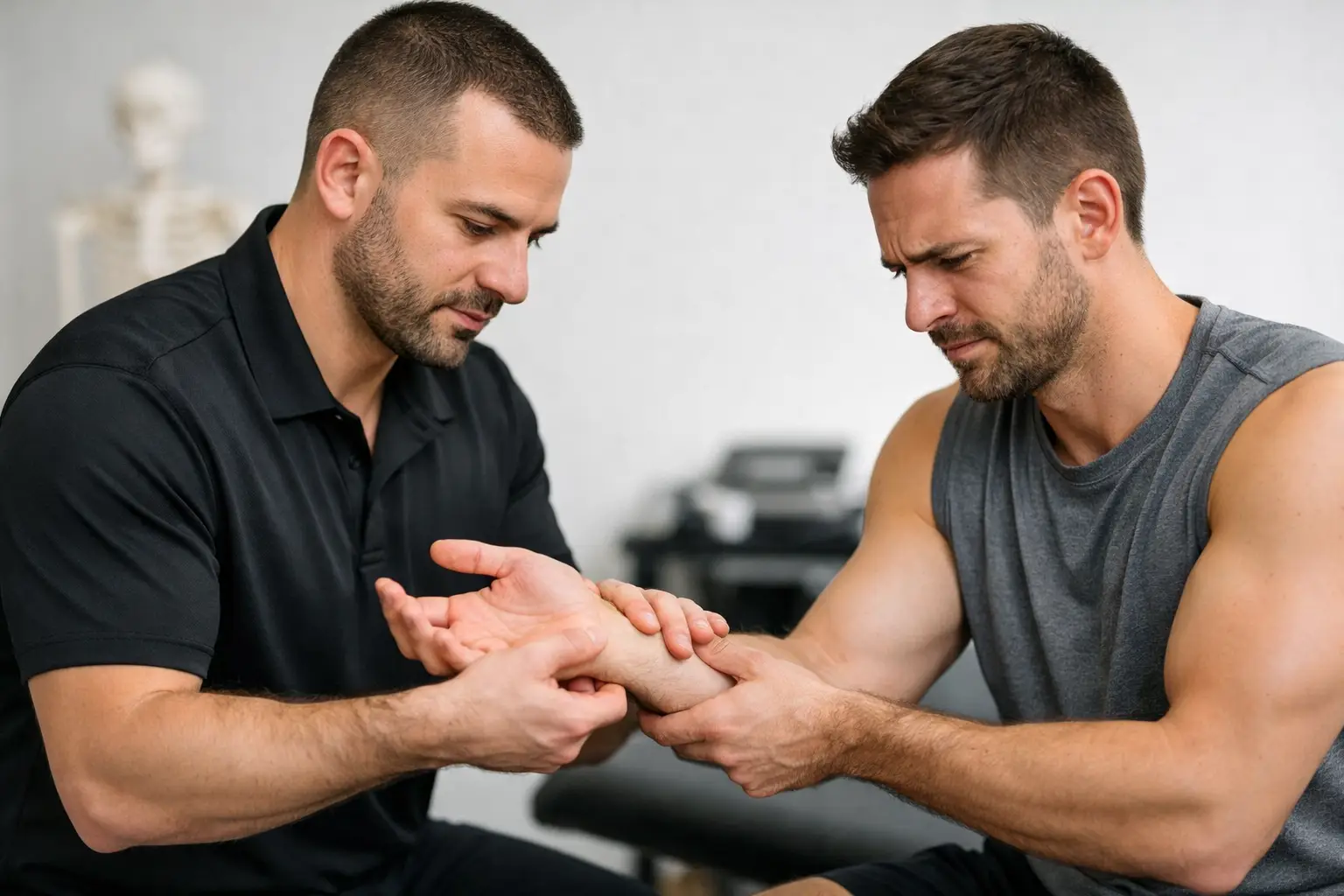
A heavy front squat should challenge your legs, not make your wrists feel like they are being bent backward under a bar. The same goes for push-ups, bench press, kettlebells, pull-ups, and even gripping a dumbbell. Wrist pain from lifting is frustrating because it can turn exercises you normally enjoy into movements you avoid, modify endlessly, or push through until the problem gets louder.
The good news is that wrist pain does not automatically mean you need to stop training. It does mean your wrist needs more than a quick stretch between sets. The best next step is to understand what the movement is asking of your wrist, what your current capacity is, and how to close that gap without losing all momentum in the gym.
Why wrist pain from lifting is rarely just a wrist problem
The wrist is a busy joint. It needs to transfer force between your hand and forearm while adapting to gripping, pressing, pulling, loaded extension, rotation, and impact. When it becomes painful, the issue may involve local irritation in the tendons, joint, ligaments, or surrounding muscles. But the reason it keeps showing up is often bigger than one sore spot.
A sudden jump in training volume is a common trigger. Maybe you returned to lifting after time off, started a new CrossFit program, added more pressing, or increased your deadlift volume. The wrist may simply be dealing with more load than it has been prepared to tolerate.
Technique and setup can matter too. A front rack position that forces the wrist into aggressive extension, a bent wrist during bench press, or a death grip on every pulling exercise can make symptoms more likely. Limited shoulder mobility, elbow control, forearm strength, or upper-back positioning may also shift more stress into the wrist.
That does not mean every case needs a complicated explanation. Sometimes a wrist is irritated because it was overloaded. Still, if the pain keeps returning after rest, massage, or a few generic mobility drills, it is worth looking at the full picture rather than treating the wrist as an isolated problem.
The lifting movements that commonly aggravate wrists
Pressing movements often bring wrist symptoms to the surface because they load the wrist in extension. Push-ups, burpees, bench press, overhead pressing, and hand-supported exercises can all be uncomfortable when the wrist cannot tolerate that position yet.
Front squats are another frequent culprit. The traditional front rack requires a combination of wrist extension, elbow elevation, shoulder mobility, and bar support. If one area is limited, the wrist may absorb the compromise. This is why some lifters feel sharp discomfort before their legs have done any meaningful work.
Pulling and gripping exercises can irritate the other side of the wrist or forearm. Deadlifts, rows, pull-ups, farmer's carries, kettlebell work, and barbell curls can expose issues related to grip tolerance or repetitive tendon loading. Even long workdays at a keyboard can lower the amount of extra stress your wrist tolerates in training.
The pattern matters. Pain only during a deep push-up position is different from pain during gripping, rotation, or day-to-day tasks like opening a jar. An assessment should consider where it hurts, when it hurts, what changes it, and what the wrist can still do well.
Do not confuse training around pain with solving it
Training around wrist pain can be smart in the short term. It becomes a problem when every modification is permanent and no plan exists to rebuild tolerance. Swapping barbell pressing for neutral-grip dumbbells, using push-up handles, reducing range of motion, or using straps temporarily can keep you active while symptoms settle.
But a workaround is not the same as a progression. If you want to get back to front squats, Olympic lifting, gymnastics work, or heavy pressing, your plan eventually needs to reintroduce the positions and loads that matter to you.
What to do when your wrist hurts during training
First, adjust the aggravating movement instead of repeatedly testing it at the same painful load. Reducing weight, volume, range of motion, or frequency can lower irritation while preserving the pattern. For example, a lifter with painful push-ups may start with elevated handles or dumbbells, then gradually work toward floor-based pressing as tolerance improves.
Next, look at your setup. During pressing, aim to keep the load stacked more directly over the forearm rather than letting the wrist collapse backward. During barbell work, consider whether grip width, hand position, rack height, or the type of bar is making the position unnecessarily demanding. Small changes can make a meaningful difference, but they should support a broader plan rather than become the only strategy.
Then build capacity. This may include controlled wrist extension and flexion work, forearm strengthening, grip training, pronation and supination exercises, and progressive loading through the positions that currently feel limited. The right exercise depends on your symptoms and goals. A climber, powerlifter, office worker, and CrossFit athlete may all have wrist pain, but their return-to-training progressions should not look identical.
Pain during rehab is not always a sign that an exercise is harmful. Mild, manageable symptoms that settle appropriately can be part of rebuilding tolerance. Sharp pain, escalating symptoms, swelling, new numbness or tingling, obvious deformity, major loss of strength, or pain after a significant fall or impact should be assessed promptly by a qualified healthcare professional.
Why rest alone often falls short
Rest can calm an irritated wrist, especially after a recent flare-up. It is useful when it creates space to reduce symptoms and identify what is provoking them. The limitation is that rest does not automatically prepare the wrist for the same training demand that caused the issue.
That is why people often feel better after a week or two away from the gym, then feel the pain return on the first heavy session back. The tissue may be less irritated, but its capacity has not changed much. The same can happen with passive treatments that provide short-term relief but are not paired with movement changes and progressive loading.
Hands-on care still has a role. Soft tissue therapy, joint mobilization, chiropractic treatment or adjustments when appropriate, cupping, Class IV laser therapy, or shockwave therapy may help reduce symptoms or improve movement for some people. They are tools, not standalone fixes. The bigger goal is to use any symptom relief as an opportunity to train better, restore confidence, and build a wrist that can handle your actual demands.
A better plan for returning to lifting
A strong return-to-lifting plan starts with a detailed assessment, not a guess. You need to know whether the biggest limiter is wrist mobility, local strength, grip tolerance, training load, pressing mechanics, front rack position, or a combination of factors.
From there, progression should be specific. If push-ups are the goal, start with a version that challenges the wrist without overwhelming it, then gradually lower the incline, increase range, add reps, and eventually restore full floor work. If front squats are the goal, mobility work may be useful, but it should be paired with practical options such as cross-arm variations, straps, lighter rack holds, or controlled exposure to the front rack.
The same principle applies to load. Going from no pressing to max-effort benching is not a rehab plan. Gradually increasing resistance, repetitions, time under tension, and exercise complexity gives the wrist a chance to adapt. Some weeks move quickly. Others require a slower pace, especially if work, sport, sleep, or other training stress is high.
At Ground Up Chiropractic and Rehab in Hamilton, care is built around this kind of process. A movement assessment helps identify the factors that may be contributing to your symptoms, while hands-on treatment can be used when it supports progress. The focus then shifts to individualized, gym-based rehabilitation that builds the strength and confidence needed for training, work, sport, and daily life.
Your wrist does not need to be treated like a fragile joint. It needs a clear plan, enough recovery, and a gradual return to the loads and positions that matter to you. If you are stuck modifying every workout or dealing with the same flare-up after every return to the gym, book an assessment and get a better understanding of your next step.
